Reality bytes

Today I went with my wife for a tour to Dharavi in Mumbai. This is one of the largest slums in Asia. There are almost a million people living in an area of less than two square kilometres. A home is less than ten square feet and on an average houses five adults. It is indeed an eye opener. You need to visit the place to believe it. We went through an organization, which organises these tours and partly gives back its profit to support the people and children living in Dharavi.

The first part of the tour is the commercial area. In this part, thousands of men and women are working in different types of industries. The first sight of old car bumpers getting shredded and recycled as plastic beads to be moulded into chairs and other plastic durables. Then we pass through suitcase makers, the leather soles for shoes, leather bags, bakery and food items being made for consumption within themselves as well as for sale around town.

You realise how difficult are the working conditions. In dark room with minimum light people inhale dust and paint flakes as they shred material waste to generate the raw material for plastic remoulding durables. People from the remote parts of the country are working day and night leaving their families behind just to earn a livelihood. We realise how privileged we are even to be born in middle class families. Our parents take care of our education, provide us a place to stay and a decent standard of living.

Then you move to the residential area. We see people from different states of India and following different religions living peacefully together. It is here you realise that wealth may not help you buy happiness. You see children, adolescents and adults enjoying each other’s company and helping each other in their daily chores. You see happiness writ on their smiles and this makes you realise that it is not materiality which can bring you happiness in life.

You also see schools – run by government, NGOs and private organisations. While the government and other organisations are tying their best to improve the quality of their lives, the problem is mammoth. One good thing I noticed is that I did not see children working in the commercial areas although this cannot be totally ruled out.

Some of my reflections and learnings after today’s tour are –

A. We need to be grateful to God and our parents/elders for all the comforts we enjoy in life and never realise their value

B. We realise that happiness is not directly correlated to the wealth we possess. Rather happiness is a state of mind and attitude to life.

C. We also need to realise that we need to give back to society more than we get as are indeed much more privileged than millions of people around us.

As in the photo a( courtesy – Reality tours & travels)above, children sitting in a cart within the slum seem happier than many of us. We realise how privileged we are in life.

What do you think ? Is it time to reflect ?

S Ramesh Shankar

Anything in excess is unhealthy ?

Anything in excess is unhealthy ?

I have lived in India throughout my life. We have a temperate climate throughout the year.  It is mostly sunny and temperatures range in the mid thirties centigrade in most parts of the country.  We have got used to it and have acclimatised ourselves to this weather.  One interesting thing I have noticed is that our eating habits and even our clothing patterns are determined by the weather of the place we live in.  This is nature’s way of helping us to adapt to the vagaries of the weather.

Many of us tend to complain when it is very hot during summer.  We pray to God to keep the Sun away for a few days.  On the other hand when it rains in the monsoon, we eagerly look forward to the rains.  The environs are green and we enjoy it for some time.  But as the rains persist and our daily life gets paralysed, we pray to God to keep the rains away.  Three months of rains and cloudy and murky days make us depressed and we want the Sun to come out again.

It is an interesting cycle of life.  We hate the Sun when it is hot and hate the rain when the Sun does not come out.  We look forward to the winters to have some fun.  But when the temperature dips below zero degrees centrigade in some places we again regret.  So, heat, rain or cold is not tolerable, when in excess.  This implies that anything in excess is not good for life.   The earlier we realise it the better it is for us.

If we look at our eating habits also this axiom would be true.  We may like sweets and may enjoy eating them.  But if we have excess of sweets, it may be harmful for our health and at a later stage we may end up with diabetes.  This is also true for any of our habits and hobbies.  Walking is good for health.  But at the same if we over stress ourselves by going for endless walks every day we may harm our health more than benefit from it.

This means anything in life in excess may not be good for us.  We need to strike the right balance for everything.  It does not matter if it is food, hobbies or work.  We have to strike a balance between work and home.  If we over strain ourselves at work, our relationships at home could get impacted.  If we do not work hard and are content in spending more time at home and less focus on our work, our career could get impacted.

Even in life, we need to ensure that we do not go overboard on anything. This means that good life is all about balancing and optimising resources.  Excess of anything may be harmful.  We wish our kids to put on weight when they are babies.  But over weight and obese children may never be the healthiest.  It is up to us to draw the line for everything and know when we are crossing it.

In the photo above, the sun was welcome after a long long monsoon in Mumbai.

Life gives us enough opportunities and resources.  It is up to to manage it well.

S Ramesh Shankar

Born to be “Happy”


We all are born in life with equal measure of joy and sorrow. All of us go through life with all its ups and downs. While some choose to be happy others are sad. I some times find even when people go through similar events in life, some drown themselves in sadness, while others bounce back even before the event is over.

It may be fair to say that God gives us joy and sorrow in equal measure. God also bestows us with the things we want in life as per our needs. But some are happy while others are sad under similar conditions. If we try to understand this better, we realize that the environment is the same and the benefits similar to different individuals. But some choose to be happy, while others unhappy because God always fulfills our needs and not our greed.

In my view, life always has choices. We can choose to be happy if we want to and unhappy if we choose to. One factor which may help us to choose happiness in life is contentment. If we are content with what we have, we may be happy always. On the contrary, if we are greedy to want more all the time, we may never be happy because there is always be a gap between what we have and what we want in life.

I have always admired people who are happy in life.  While some may wonder if they are over optimistic and not realistic in life. In my view, it is not over optimism. It is one’s ability to bounce back. Even the happy go lucky people face tough and sad situations in life. It is their ability to take it in their stride and bounce back much before others sense their sadness.

Let us take some simple examples from life. If one loses a match, the choice for the players is to sink in sorrow and brood hours over why they lost. On the contrary, we see sportspersons, who take it in their stride and look at lessons learnt and bounce back even before we realize that they lost the match.

A child can easily teach us of how to be happy in life.  Even when a child is injured either physically or emotionally, they spring back even before we realize it.  It is this ability of a child we forget as we grow into adults.  We refuse to let go and hence take time to revive ourselves.   We just need to kindle the child in us under trying circumstances.  

All of us would have also met people in our lives who look happy at all times. It is not that they do not have their share of miseries in life. It is their ability to absorb, adapt and recotiate.  They realize that others in the world also face similar miseries and possibly their miseries are less grave than others. They choose to be happy and forget their miseries at the earliest. It is this quality, which we need to imbibe from them. We do not need to go around the world to search for them. They may be present amongst our own family, friends or colleagues in the workplace.

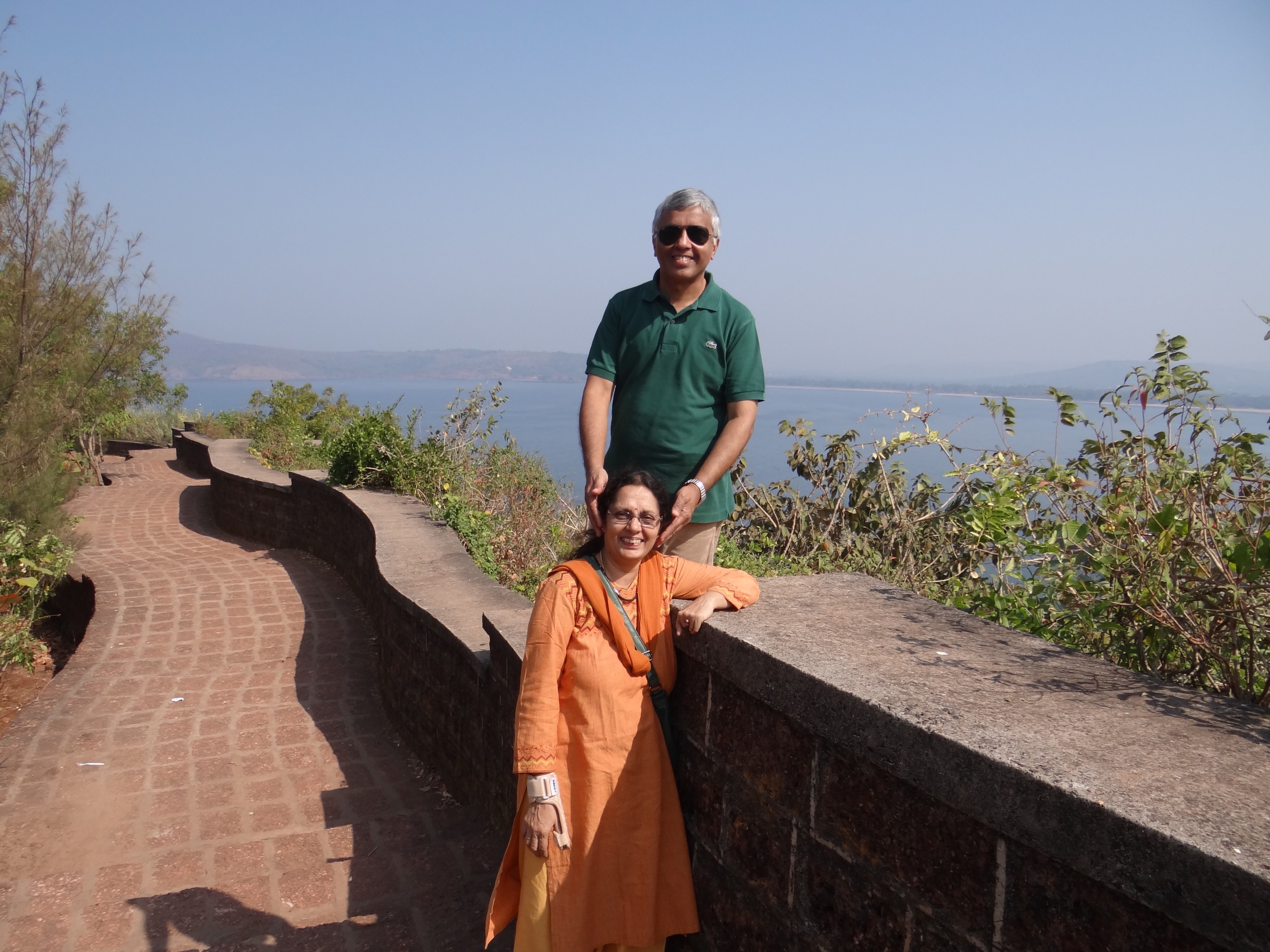
As in the photo above, I learnt this attribute from my wife. 

Let us choose to be happy and spread happiness around us always.

S Ramesh Shankar