Insecurity of the boss

One of my colleagues at work is a prolific writer. He writes articles regularly and also publishes in magazines and newspapers. He is proficient in professional areas as well as fiction. One day he called me to inform that I will not see his articles in newspapers or in the public domain anymore. I was surprised and enquired as to why he suddenly lost interest.

He called me back to tell that his boss has asked him to stop publishing articles in the public domain like newspapers, magazines etc. I asked him the reasons for the same and he had no answers. He said his boss feels that a lot of his time is spent in writing articles and thereby he is not able to contribute much within the organisation.

I had advised one of my colleagues who worked with me to utilise every opportunity to represent the organisation and present papers and participate in discussions in academic and professional circles. I was surprised that one day she called me to state that her current boss has started questioning her participation in these events on the basis of time spent (even if most of them were on weekends) and also on their impact to the business.. I wondered why and when asked for the reasons her explanations were not very convincing.

This led me to the insight that many managers are insecure of their own team members. As parents, all of us want our children to excel in whatever they pursue. We want them to do better than us both in their career and in life. Then how is it different for a manager or a leader. Many leaders are wary of their own team members. If my boss calls one of my subordinates directly and interacts with her, I am worried.

Similarly many managers themselves want to make all presentations in leadership team meetings and do not want to give opportunities to their team members. They may justify this by stating that they cannot take the risk of failure or afford any goof up in front of senior leaders. I beg to differ. If we cannot take risks with our own team members, with whom will we take ?

Imagine a senior cricketer thinking that if he coaches a budding youngster and the junior excels, he may lose his place in the team. A true leader will always want his team members to do better than himself. One of the primary responsibilities of a leader is to develop their own team members. If leaders feel that projecting their team to the outside world will expose their weakness, they are only fooling themselves.

On the contrary, the best of leaders I have seen and worked with in my career have always promoted and facilitated their juniors with potential to try and even fail. After all, none of us can excel unless we get an opportunity to fail, learn and improve. As a leader, I should use every opportunity to promote my team members. The more I promote my team, the more I am respected as a leader. We can give all the credit if they succeed and own responsibility if at all they fail.

I recall one of the quotes of the legendary JRD Tata. Once when many leaders from the TATA group left and became CEOs of other companies, somebody asked him if TATA is producing leaders for other companies. JRD replied that he is happy that TATAs are producing CEOs for the country. This is leadership in action.

The more I am worried about displaying the talent of my team members in public domain, the more insecure I am as a leader. Further, really talented people will be wary of working in my team. The earlier a leaders learns about this insight, the better it is for his or her own career.

We need to remember that our security builds security of our team members. The more insecure we are, the more insecure our team members feel and behave. The more we expose our team members to the world outside, the more we get recognised as a leader. A true leader should be almost invisible and work only in the background.

The insecure boss is like the king of the past, who never left his seat for the fear that someone else may occupy it if he leaves it even for a few hours.

Every leader needs to realise that their own insecurity is their weakness rather than the weakness of their team members. The earlier they realise it, the better they will grow as a leader.

Let us learn to develop ourselves by developing our team by giving them all possible opportunities to learn and grow both within and outside the organisation.

Lets try from today.

S Ramesh Shankar

15th May 2021

Surviving a crisis in life

There are some moments in life which drown you in a sea of grief. Losing a near and dear is irrevocable. It feels as if the sun has set in your life and will never rise again. You also feel as if the moon will not light the night sky. You feel lonely but want to be left alone. No words of comfort can console you. You have no tears to cry in your eyes

I have gone through such moments in my life. I lost my mother at 23 and my father at 25. It was in quick succession and I had just started my career at 22. Fortunately my sisters were married and settled and I had to only take care of my younger brother. But still the question, which haunts you at such moments is – “Why me “?

You have led an honest life. You have been good to everyone around you – family, friends and relatives. You loved your near and dear one the most and God has snatched him/her away from you. You not only wonder why but also wonder why only you. These are normal feelings and anyone facing this situation will go through. No words of consolation soothes you. You get no answers from God or anyone around you. It’s only time, which heals you and not the words, conversations or people around you at this time of grief.

Your world is lonely. The gush of the wind is not heard by you. The song of the birds do not lighten your somber mood. The sound of the waves in the sea reverberate your hurt feelings. You lose faith in yourself and in God. You may stop visiting temples, churches or mosques irrespective of whichever religion you follow.

It is only time, which may heal you. It is at this juncture, you need to believe in yourself. You need to be a supportive partner to your family. Together, you need to weather this storm. You need to take courage from poor people, who live in small hutments near the sea. They face the wrath of the rains every year. The thunderstorms blow away their houses, their belongings and sometimes even their near and dear ones. They may be fisherfolk and fishing is their only source of income. So , they come back to the sea to start their life afresh.

Our life may not be very different. We may face one crisis after another. We may lose faith in ourselves and in others. We may also lose belief in God. But as time heals our wounds, we need to limp back to stand up and live life all over again. We need to look for people around us, who may have lost much more than what we have. We need to seek blessings and express our gratitude to God – to bless us for all that we have and give us the courage to bounce back. During such crisis, we need to be thankful to the people around us, who stood like the boulders on the ocean front, which faces the wrath of the sea waves every year to protect us from damage and destruction.

We need to believe that the sun does rise next morning after every sunset. Even the moon resurfaces after a no moon day. We do get rewarded for our efforts. We have to be thankful that we did our best and sometimes a crisis in life is inevitable – may be not in our hands and it could be nature’s way of helping us keep our feet on the ground.

Our life ahead is an opportunity. We need to learn to bounce back. Let time heal your scars and I am sure you will find ways to bring joy to others. You may get an opportunity to take care of other people like your own. You could think of all the good memories with your near and dear one and all the joy he/she brought into your life. It is sweet memories of our lives, which keeps us going in good and bad times.

The clouds do settle down and the blue beautiful sky returns after some time. We need to wait patiently for the blue sky to return in our lives as in the photo above. There is nothing permanent in life.

Selfless service and gratitude to those who stood by your side during your crisis are useful ways to bounce back in life. Wish you all the best.


S Ramesh Shankar

4th Sep 2021

PS : Dedicated to everyone who has lost someone close to their heart in their lives.


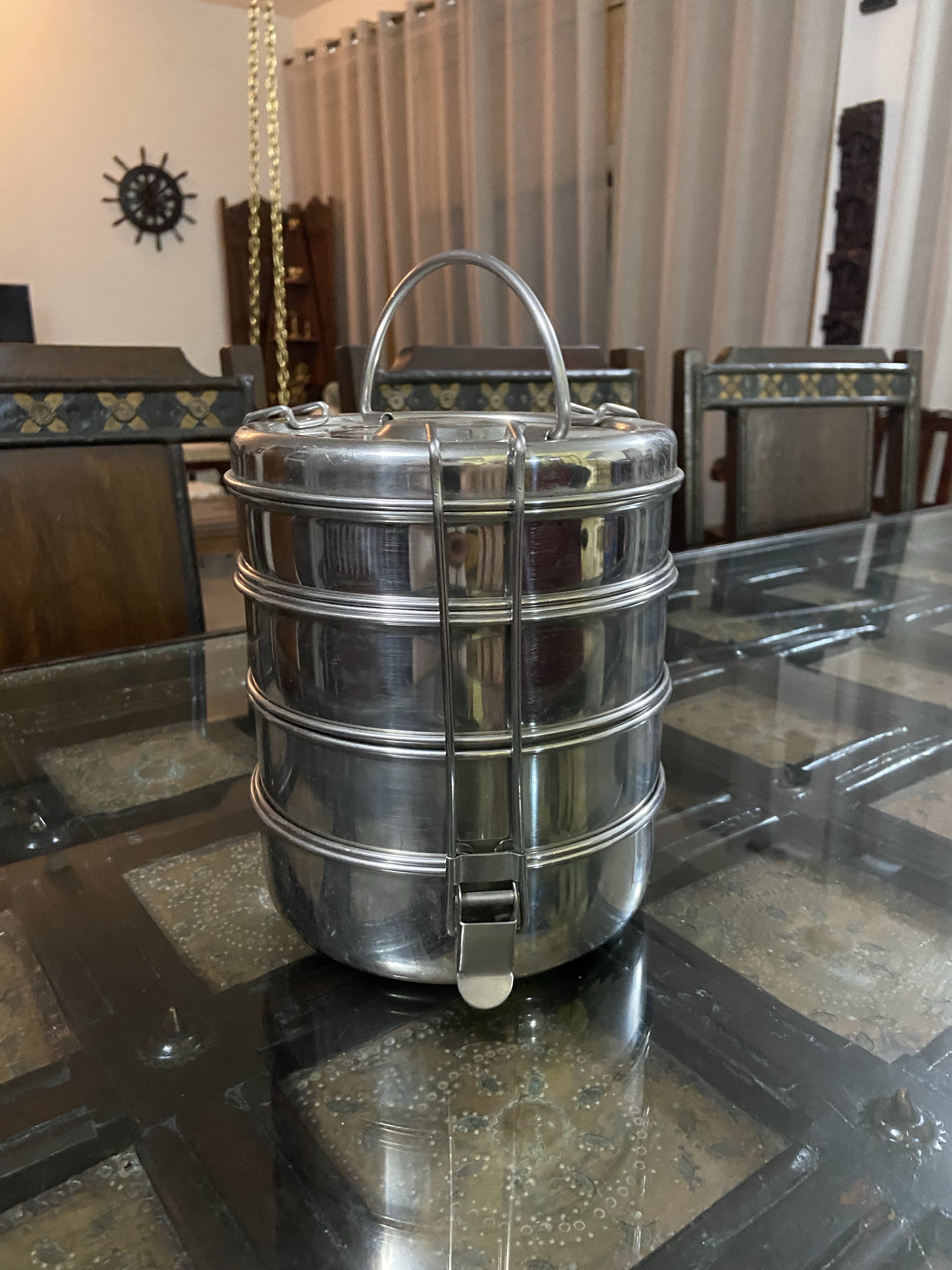
Tiffin carriers

The tiffin carrier has been a symbol of many things over time. The basic purpose of a tiffin carrier may have been only to carry food for consumption when you are hungry during any time of the day as you prefer.

However, over a period of time the same tiffin carrier has symbolised different things to different people. The oldest known utilisation of the tiffin carrier was the media of communication between two people. It could have been an innocuous message from a mother to her child or a wife to her hubby.

It later transformed as a messenger service in the pre-digital age. Romantic lovers used the tiffin carrier as an innovative medium of communication, which was indirect and at the same time kept the novelty and inquisitiveness alive at all times. They were used to sending slips inserted in tiffin boxes to their beloved partner.This helped many young couples bond relationships while may have also split a few of them due to mis-communication in the process.

Nowadays tiffin carriers have become popular again and used extensively by food carrier apps and also food delivery services in metro cities for dual career couples. The purpose could be ensuring timely delivery of food apart from saving a lot of valuable time for the working couples, students and single men and women.

What amuses me most is the use of the tiffin carrier to carry food for your family members after you attend a marriage or ceremony in a friend or relative’s home. People nowadays tend to carry food for people back home after they have had a sumptuous meal in a ceremony they have been invited to.

I have nothing against having a grand meal. But it may be unfair to carry a tiffin carrier and carry food back home. This will unnecessarily add costs and inconvenience to the host. While it may still be fine to carry food for the elderly or differently abled back home, it may be better to do the same from a restaurant rather than from a party you are invited to.

Tiffin carriers are also used to send messages of errands. Parents request their children to buy some food, groceries or medicines for them. It could a be reminder to pay phone or utility bills. Thus the tiffin carrier may have been used for multiple purposes over time.

The most interesting story of tiffin carriers is that related to the “Dabbawallahs” ( tiffin carrying men) of Mumbai. This may have started many decades ago when hygienic food was not available in or near offices and factories. So, employees got tiffin from their homes and thus Dabbawallahs evolved this service.

In this service, Dabbawallahs carry tiffin from each home in a bag and code them using a color and keep them in trolleys. They are then hailed in bicycles to the nearest suburban station. It travels by trains to the nearest station of the office. Then gets re-distributed and again hailed in bicycles to the workplace of the employee. The return journey of the tiffin is similar.

These Dabbawallahs have provided a six sigma quality of service to their customers over decades. Their process is simple and there are practically no wrong deliveries. They could provide a living example to organisations of today and beat the artificial intelligence and robotics of tomorrow.

Long live the Tiffin Carrier.

S Ramesh Shankar

12th September 2018