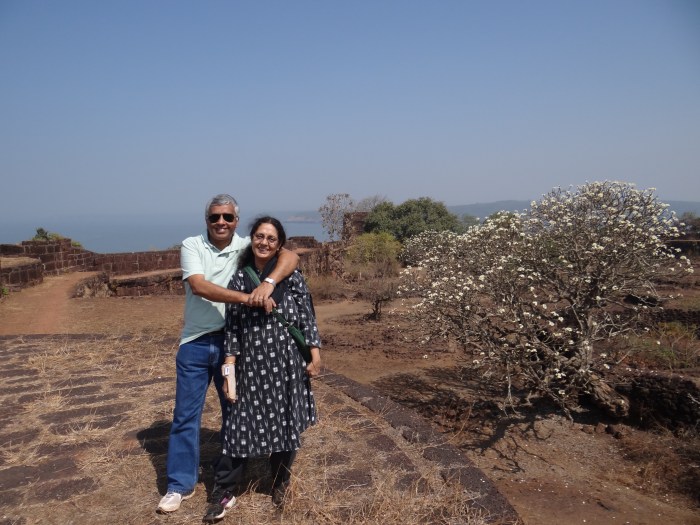
Partnerships

DSC03979

In my book, partnership is when two individuals or entities work together towards a common goal.  In real life you look at partnership with friends, family or your spouse.  The relationship is unconditional and the expectation of support is mutual.  The summation of two is more than the simple addition of  individuals.  Partnerships ensure that we complement and supplement each other in all our efforts.

Now if we look at partnerships at an entity level, it is the symbiosis of two organisations to leverage on each other strengths.  It could be with a business goal or even with a social objective.  Partnerships ensure that the entities are able to enable each other to succeed.  History is evidence to successful partnerships between companies in the corporate sector and other sectors.

In today’s world, we also see partnerships between two countries.  It could be technological partnership, social  or any other field of common interest.  When multiple countries join hands it may end up as multilateral colloboration among those countries.  The success of partnership depends on mutual respect for each other’s strength and ability to give as much as your receive.

Interestingly, partnerships at individual, company level or country level are based on similar principles.  The first principle of partnership is the choice of the partner.  If you have to fully thrive on the benefits of a partnership, you have to choose the right partner for setting up for success.  A simple example could be the choice of your partner in a team sport like tennis.  If you choose a partner who complements your strengths and manages your weakenesses, then you are sure to succeed.

The second principle of partnership is mutual trust.  No partnership in the world can succeed unless they trust each other unconditionally.  After you have selected your partner, you need to ensure that your trust unconditionally.  The moment one of the partners seeds mistrust, the partnership is doomed to fail.  History is witness to successful and failed partnerships in the corporate sector.  If we examine the reasons for success or failiure, trust would be a defining factor in all such cases.

The third principle of a great partnership is giving your best and enabling the other partner to succeed.  This is true at individual, organisational or country level.  The best of partnerships thrive when they give their best and enable each other to succeed.  We can examine this character in all successful partnerships.  We will find that the more you give, the more likely you will reap the benefit of the partnership.

Thus, partnerships thrive on choice, trust and giving.  It is equally true at individual, organisational or country level.  It may be worthwhile to mention that none of us as individuals can succeed in society without establishing partnerships.  If married, you thrive only when you are able to complement your spouse to succeed.  It is equally true in companies and nations.

It is time to partner .

S Ramesh Shankar

Smile please…

IMG_3493
Our facial expressions speak more than our words.  There is research to state that we express ourselves 70% of the time through non verbal behaviour rather than verbal.  This means smiles can not only be contagious but can make a huge positive impact in our lives.  Then, it may be worth while to examine as to why we are so stingy in smiling.  Many of us find it difficult to smile unless a situation forces us to do so or we do it as an obligation to others.   Interestingly there is also medical research to confirm that smiles can exercise our facial muscles better than frowns.

It is time to examine the reasons for our smiling or otherwise. We get up in the morning, brush our teeth and feel quite comfortable smiling at ourselves at the mirror.  We have our cup of coffee with our family and friends and the smile may continue to blink.  As the day progresses, we meet people on the way to work or school and the smile disappears.  The frown may gradually replace the smile as we believe our day is worse than anyone else around us.

It is time to wake up in the morning and be grateful to God and ourselves.  We should believe that we are the luckiest in the world and blessed with family and friends, who are so caring and loving around us.  We should look forward to getting to work or school and meet our wonderful colleagues.  This may not only make us more confident and cheerful but will spread happiness all around us.  It may make us feel good and spread goodness with every smile on our face as we interact with others.

Why blame the world for a negative attitude if we can change the world with our smile.  Another interesting dimension of a smile on our face is that it is very contagious.  It is almost like yawning.  Have your ever tried it ?  If you look at people yawning around you, you end up yawning yourself even if you are not sleepy or feel like it.  Smile is similar.  Try it.  If you meet someone who smiles around all the time, the spread of cheer is infectious.

It may be interesting to examine as to why we smile less and frown more at ourselves or at others.  It may be because of the imbalance between need and greed in life.  We are accumulating wealth with the belief that wealth may lead us to prosperity and which in turn may make us happy.  This quest for wealth is endless and leads us from need to greed.  The moment greed overtakes need, we tend become angry with ourselves and more greedy.

On the other hand, we meet people on the street, who are never sad.  They may not be the wealthiest in the world but they are the happiest.  If we examine them better, we may realise that they fulfill their needs in life and never are greedy.  They give more than they get in life.  Their smile is generous and unconditional.  They do not smile at you because they need you but they smile at you because they want to make you happier every day.

On the other hand, many of us carry the burden of the world on us.  We believe that the world is cruel to us.  We believe that we do not have enough for a happy future.  We are in the never ending quest for wealth.  We yearn for a future, which is always eluding us and in the process forget the existence of the present.   We forget the past as soon as we reach a stage of self denial.  This makes us smile less and frown more.

It is time to wake up.  Let us smile at ourselves and at others.  Let us cheer ourselves .  Let us spread happiness around us like a flower spreading honey to the bees.  The world will be a happier place to live in.

Lets start today

S Ramesh Shankar
January 2017

Think before you ink

IMG_5815
Our ability to think before we ink may help us determine our future.  This may be the true barometer of a democracy as much a measure of our true success in life.  Let us first examine this hypothesis on what is a true democracy in society at large.  A nation, where every citizen can at free will express herself or himself without any repercussions or consequences is the foundation of a true democracy.    A country where the vote of every citizen is equal and valuable in determining its future is the crux of a democratic state.

I am lucky to be born in India, the world’s largest democracy and thriving for the last 60 years and counting.  We are multi cultural, truly secular and thrive on democratic values.  We may not be the most prosperous country in the world in money terms but we are the wealthiest in the world in emotional and spiritual power.  This has been possible only because every citizen of India determines our future.  Our constitution makers have ensured that every citizen contributes to the making of India.

The vote of the citizen in India is equal irrespective of whether you are rich or poor and whether you are educated or illiterate.  We are the first country in the world to have 100% electronic voting machines almost a decade back and we proud of our democratic credentials.  While the election commission of India, which is a constitutional body plays the role of an independent watchdog to protect and promote the rights of its citizens, it is each of one of us as independent citizens, who have contributed to this success by thinking before we ink in every election.

Now, if we move to the individual, the significance of thinking before we write something is equally important in our lives.  While everyone does appreciate the value of communications in life, it may be forgiven if we use inappropriate language verbally and seek forgiveness as soon as we realise it or someone points it out to us.  It may be erased from memory and easily forgotten too.  However, what is written down stays engraved in stone and lives in memory for eternity.

We need to think before we ink.  This may be easier said than done. In an era of emails and mobile communications, there is more communication through written forms of emails and chats rather than speech.  This makes it all the more necessary for us to think before we write.  We need to choose every word with caution and imagine the impact of the words we choose on the recipient of our communication.

We need to realise that it is easier to speak than to write.  The more we think before we ink, the better may be our expression and the more its impact.  It is we, who determine how others perceive us.  It is we as citizens determine the future of our country. The kid in the photo above seems to be thinking intensely before he puts his thoughts on the iPad.

Let us think.

S Ramesh Shankar
January 2017