Where West meets East..

I love my country. India is the biggest and the most vibrant democracy in the world. We may not have the best physical infrastructure in the world but we have the best emotional quotient. We care for our people and we care for the world. “Vasudeva Kuthambakkam” is a old Sanskrit saying. It means the world is one family. We believe in this tenet and try our best to live it every day in our thought and behaviour.

The other day I was flying down from Mumbai to Chennai. It was from the west coast of India to the east coast. The state where I currently live and work is on the west coast. The place where I was born and bought up is on the east. The language they speak and the culture of the two states are completely different. The type of dress they wear and the customs and traditions are also quite varied. But, what is common is our emotional connect. We live and breathe as Indians.

Today the western civilisation has invaded us. We have got the best of technological advancement from the west. We have learnt the traditions from the East and have blended the west to the east to get the best. We need to be proud of our past and confident about our future. We need to learn the best from the west and leave the traditions of the east to continue to thrive in our country so that we get the best of both the worlds.

We have 29 states in India and each has its unique culture. We have hundreds of languages and dialects. While Hindi and English is spoken and understood across the country, we do not have any problem in living or dealing with each other wherever we live. The reason behind this in my view is because by heart we are an Indian. We are brought up with a tolerant attitude to life and living.

We need to continue to learn and grow this tolerance in us. No religion, caste, creed or community should create barriers between us. While vested interests in society may intrude into our culture, we have a responsibility to preserve it and promote it for the future generations. We cannot afford the evil forces of society to impinge on the fabric of our cultural society.

We have to be proud of the past, while we create a future of our choice. We have adapt and adopt the best of technological advancement without compromising on our values or ethics. We have to embed our culture in our younger generations. In my view culture is like the blood in the body. No foreign organism can destroy the blood as long it is pure and has the immunity to fight all external forces.

We need to remember the best traditions of the past while we embrace the best technology for the future. Both need to coexist. We need to remember that our culture is the bedrock of our society. It is the foundation of our democracy. It is the bloodline of our society. We should neither allow our culture to degrade nor dilute due to the invasion of technology.

We have a rich tradition of science in our country. We have to embrace science for the betterment of mankind. But we need not do that at the cost of traditions. In my view, culture and technology are like two our two eyes. While one may be enough for sight, the two eyes provide us the third dimension of sight, which is not replicable by any technology. No camera in the world has been able to better the vision of our eyes.

The sun rising in the east or setting in the west looks as gorgeous across the Indian coast line as in the photo above on the west coast.

Let us learn to embrace technology and imbibe culture. Let the West meet the East.

S Ramesh Shankar
The Walking Encyclopaedia


We had a teacher in college by name Professor PK Vishveshvaran, whom we called the “Walking Encyclopaedia”. Anyone of the students had a query on any issue, she would go to this teacher and he always had an answer. If he did not know the answer, he would neither guess nor fake an answer but accept that he did not know. Further, he would commit to find the answer and get back to the student. It was in the early eighties, where computers and the internet was non existent.

Most of us were in awe of this professor. He was a simple, down to earth and a knowledgable professor, who had no pretensions. He was accessible to everyone and always willing to help. I have not yet met a teacher in my life, who is so endearing. He used to keep a radio in his room and listen to music and news from around the world. His room consisted of open shelves and he used to meticulously maintain reference materials in a very haphazard manner, which only he could retrieve. But the best part was that he could retrieve any information within minutes from a maze of shelves, registers, books and papers.

I have learnt a lot from this teacher in my life. He is like a role model for me in many ways. The first learning is that he led a very simple life and was always willing to share his knowledge with others. Hence, one could learn that simple living and high thinking is easy to admire but difficult to imbibe. Further, the belief that the more you share your knowledge with others, the more you learn and grow in life is something I learnt from this wonderful human being.

The second learning I got from this Guru was that he never aspired for any recognition. He was an absent minded professor in letter and spirit. He used to dress very casually and mingled very well with students and everyone else. One would never get impressed with his dress or his looks. His hairstyle would be strewn all over. He never dressed to impress. On the contrary, you will wonder whether he could be a master of his subject by the way he presented himself. However, the moment you interact with him for a few minutes, you realise what a reservoir of knowledge he was.

The third learning I had from this lecturer was that he was a life long learner. I have seen him from my college days till he lived.,I have always seen him curious and enthusiastic. He had the memory of an elephant and the inquisitiveness of a child. He always had questions to ask and did not hesitate a second to say – ‘he did not know” ? I have always been humbled by his presence and humility.

Sometime back I came to know that he was admitted to a ICU after a slip . His nervous system had been impacted. As soon as this information spread, students from all over the world prayed for him and were generously contributing to support him to recover. The prayers were answered by God within 24 hours and he became conscious and did recover. I did realise that a wonderful human being like him should never suffer from any disease or injury. God was kind to listen to the prayers but he did not survive for long.

I also recall that he attended every alumni meeting of the college and remembered me and my wife from our college days. He would recall the name of the place where I first started my career thirty six years ago and reminded me of the post cards he used to write to us. He took the three books written by my wife and promised to read them and send his feedback and review again through a post card. I recall he said – I will send a snail mail as I am not yet used to emails.

Unfortunately, he died last year. What a great human being he was ? I pray to God to help us learn from his humility and be s better human being.

S Ramesh Shankar

Maturity versus Immaturity


One of my young colleagues asked me where does maturity end and immaturity begin ?  It is difficult to answer.  He was shocked at his interactions with one of his key stakeholders.  While it started off very maturely and informally, it ended with a bad taste in the mouth and a sense of immaturity. So, the question is ” where does immaturity begin and maturity end or vice versa ?” 

When you interact with someone senior, you assume that the person will be more mature than you.  Maturity is relative.  It has to be experienced to be believed.  Age and experience does not necessarily guarantee maturity in anyone.  I have met a lot of young students and aspiring professionals, who have displayed exceptional maturity.  On the other hand, I have met senior professionals, who are yet to mature.

So, how does one deal with immaturity ?  In my view, maturity is a state of mind.  It has to evolve for a person.  Some of us gain maturity early while others take more time.  It is our ability to adapt to different kinds of persons and their relative level of maturity that makes us successful.  We may sometimes take light hearted humour as informal.  Then it may lead to informal interactions and then when one fine day informality is misunderstood by the other person, it hurts us and is termed as immaturity.

Does it mean that we should avoid informal interactions ?  I would not say so.  I always believe in creating a work environment, where informality prevails.  We should not only be physically accessible to our team members and colleagues but also mentally and emotionally at all times.  However, we need to learn where to draw the line.  It is easier said than done.  One needs to learn by experience where informality ends and formality begins.  It is a very thin line and we are bound to err many a time.

So this colleague asked me –  “How to deal with the immaturity of his key stakeholder?”. One needs to gauge the behaviour of others and learn to draw the line.  The line is not dependant on age, experience or seniority.  It is based on relative maturity.  One learns to draw the line by experience and most times by facing the consequences.  It is painful at times but one learns by facing it in real life.

I have seen this phenomenon at work and even in personal life.  It happens in the family and society as well.  We find unpredictable and irrational behaviour by very senior people.  It is difficult for youngsters to deal with them.  On the other hand, we find very mature and competent young people who wear maturity on their shoulders even before they gain enough experience.

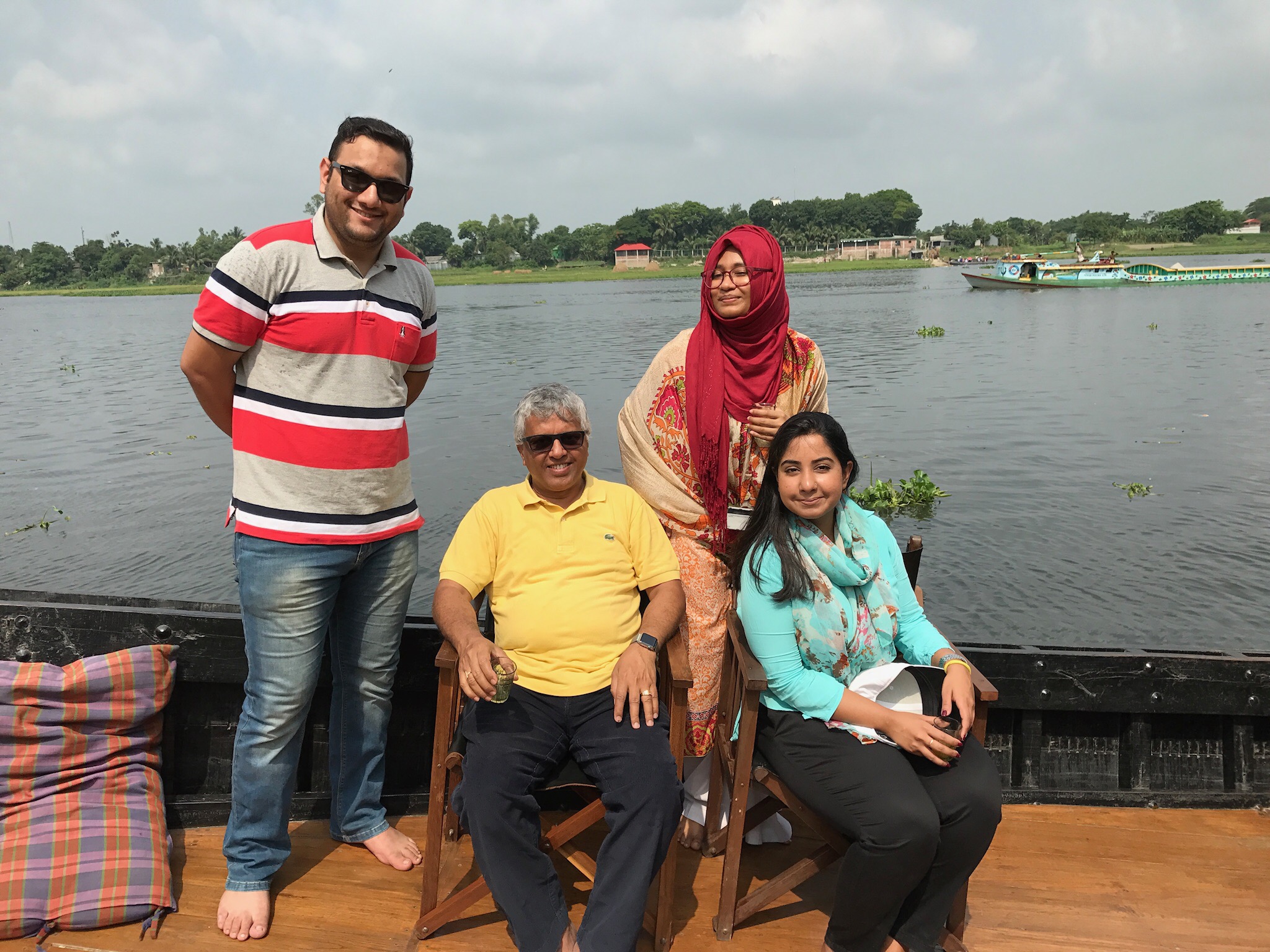
I had a lot of questions from these young colleagues (as in the photo above) during a recent team building workshop on a boat in Bangladesh.

My learning in life is to moderate yourself than attempt to moderate the other person.  It is not easy for us to mould the behaviour of others.  It is easier to adapt our behaviour to suit the style of the other person.  As I said earlier, failure may be the stepping stone to success in many situations but there is nothing wrong with that too.  After all every sportsperson wins after losing many games.  Further, no sportsperson gives up after losing, even though the road to victory may be long and ardous.

Lets us begin the change today.

S Ramesh Shankar