Loyalty may not be a virtue anymore

I was brought up in the family with the strong belief that loyalty is a virtue. I believed it and saw it being practised around my family members and in the communities I lived.

Then when I started my career in a public sector undertaking, my role model was my father , who served the central government for almost four decades in his career. It was considered inappropriate even to think of leaving a government or public sector job , primarily driven by job security which people believed ,the private sector would never offer.

Even in the community around me, loyalty was considered a virtue. This could be seen in family run businesses and even in kirana shops and vegetable vendors and so on. Loyalty was not only a virtue but was rewarded and recognised by organisations.

I remember we used to get a special award on completing 25 years in the organisation and all of us looked forward to it. After serving the public sector for 14 years I moved to the private sector and then worked for multinationals. The silver jubilee award almost became extinct and was replaced by 5, 10, 15 years awards and so on. Nowadays, employees get rewarded for serving for one full year in a organisation and the anniversaries are celebrated.

This transformation in employee loyalty ,has reflected in the social fabric of the community as well. Marriage as an institution is breaking down and may soon become obsolete. While I do agree that in the past couples coexisted in marriage , more for the sake of their children or others ,even if they did not get along well, divorce is no longer a taboo.

I have the habit of attending any employee marriage in a city I lived, if I was invited to it. Unfortunately in the last decade, one in every three marriages I have attended ,have not survived. I do not want to blame anyone for this. However, it is a fact that loyalty is no longer a virtue, in marriage as an institution too.

I am for couples to voluntarily separate and re marry if they find themselves incompatible for whatever reasons. It was sad to see couples under one roof, even though they could not see each other’s face every day , in the past. But not to believe in marriage as an institution ,may be the evolution of the next century.

If children are not loyal to their parents, it is time to realise that family as an institution is also transforming. It is normal for children even in India today to let their parents stay in old age homes and they are comfortable financing it rather than taking care of them.

While the rest of the world is learning yoga and other Indian traditions of the past, we are learning to redefine our social institutions like marriage and family from the west. It may be time for a churn ,since life is after all a full circle and we will begin all over again.

My belief is that “Loyalty is no longer a virtue in family, society or organisations. It is time to sit back and reflect on the same and move forward to the society of tomorrow.

May be time to redefine the word “Loyalty” itself ?

S Ramesh Shankar

20th April’s 2022
Back to school

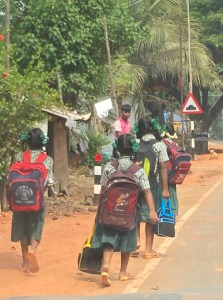
The other day I was returning from the market and I was pleasantly surprised to see groups of kids returning from school. There was a spark in their eyes and they were playing around and fooling with each other.

The pandemic paralysed life in different ways. One of the worst affected were the kids in school and college. They lost two years of real life learning in their lives. No class can teach you what life can teach you when you interact with others. The best lessons I have learnt in life is the interaction I have had with other students and teachers in my school and college life.

It could be attending a class and learning from one another by asking questions or answering them. It could be doing a project together. It could be just playing on field and fighting with each other but at the end , learning lessons on conflict resolution.

While I am a great believer in technology and use it to the hilt both in my personal and professional life, I do believe that there can be no better way to learn than experiencing life lessons every day in the real world.

The fate of employees in organisations is no different. The virtual office, video meetings and all that ensured that , life goes on and we earn our wages and serve our customers to the best of our ability. But real lessons at work are learnt when you meet one another, work along side in a project and celebrate deadlines together.

We may have attended multiple programs on conflict resolution and team work over the last two years and even got certified. However, we may find it difficult to resolve a real conflict on the shop floor ,when a section of the union , strikes work.

It is like all of us would have attended live fire fighting sessions but find it difficult to put on a fire extinguisher when a real fire hits us. Imagine the fate of the employees who have attended fire fighting course online and have never seen a fire extinguisher in real and do not even know where they are placed.

Hence, I was pleasantly surprised when I saw children returning from school after attending physical classes the other day. I hope employees are also able to get back to work and interact with one another and learn from real life experiences every day.

It is time to realise that the virtual world is not necessarily replicated in the real world. It is like the postings on social media which may not reflect the true feelings or actions of a person. It is what we see in real, which is real, the rest is illusory.

The pandemic has made life difficult for all of us. But it has also enabled us to adapt and learn. A good example is that of digital payments. We see the road side vendors, the small grocery stores or even the milkman or maids being comfortable to deal with digital payments. We possibly are the country with highest digital payment density in the world.

We need to find the gap between the virtual and the real world and learn from real life experiences every day.

Lets make life real every day

S Ramesh Shankar

8th March 2022

More than fortunate

Many of us crib day in and night out for something or the other. We crib about not having a car or being unhappy with our career or not being able to go on a holiday abroad due to the pandemic.

This cribbing nature starts from our childhood. and continues through our adolescence and even as adults. We die by comparisons in everything from food, material things, vacations and life in general.

The only catch is that we tend to compare with people who are better off than us and not the people who are not as well placed as we are. When someone points out that we need to compare with the less privileged, we shrug it off stating that it is their destiny, what can we do about it. But the same is not our destiny when we compare and feel jealous than the better off than us.

I want to share two real life stories, which can help us reflect on what life has given us and why we need to be grateful for all that we have and not crib about all that we don’t. Both these stories are real and I have personally known them. I am changing the name of the person and place for anonymity and to respect their privacy.

The first story is that of Padma who was a house help in my house in Mumbai. She is married to a carpenter and has two lovely kids. Her husband works in a garment factory. She has admitted both her children in an english medium school since she wants them to do well in their lives.

Padma’s husband is an alcoholic and comes home drunk every day and ill treats his wife and even his kids. Apart from not contributing to the family’s finances, he ends up spending all his money on his drinking habit. He further ends up with huge debts due to this habit. His wife works in 4 houses from morning 830 am to evening 630 pm every day, six days a week and manages all the finances of the house and takes care of her young aspiring children , playing the role of mother and father to the kids.

The second story is that of Radha. Radha lives in a small town of Jabalpur. Her husband was pulling carts and now runs a small petty shop. She goes around as a beautician and earns by giving home service to women who need her services. She had two sons. The younger of the two , died ten years back committing suicide because of the poor condition of the family. Radha along with her husband with their meagre income educated her elder son. He got his MBA and today works in a bank. However, at the age of 25, instead of being grateful and indebted to his hard working parents, has become an alcoholic and misbehaves with his parents, who have made him successful in life.

I had tears in my eyes when I heard both these stories. I have personally interacted with both these women and tried to counsel them in my own way.

It is time to look at our own lives with these lenses of Radha and Padma. If we do not feel most fortunate , then there is something wrong in us. We need to look at the mirror again and again till tears dry up in our eyes.

It is time to reflect and be grateful always.

S Ramesh Shankar

25th March 2022