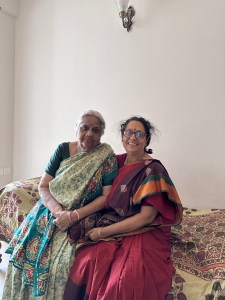
Learning from our grandparents

I have been a diabetic for the last 25 plus years. I went to specialist doctor in Mumbai a few years back for a routine consultation on the advice of our company doctor. The diabetic specialist asked me what oil I used for my food everyday. I very proudly told him that I had sunflower oil and so on.

He further asked me, as to which place ,I belong . He then asked me what my grandparents used. I told him that they consumed til oil. He advised me to stop everything else and follow what my grandparents had ,in their lives.

I realise that our bodies are attuned to the place we belong to. If you belong to the south of India, you either consume til oil or coconut oil for cooking food. On the other hand, people in the east of India consume mustard oil. The North Indians consume more wheat products while South Indians consume more rice. Our bodies get acclimatised to consuming food, which may be suitable for the weather and living conditions of the place ,we live in.

Today ,based on the marketing of products and commercialisation of everything in life, we tend to consume things which are advertised more ,than what our body needs. Our food habits and living habits are determined by commercials rather than what is good for us.

It may be time to look back and reflect on how our grand parents lived their lives. They got up at dawn before the sun rise and had a daily routine of exercise. It could be a walk or a run or playing a game. They did some puja or meditation before venturing out for their work schedules. They spent enough time with family members and always had breakfast and dinner along with all their family members.

The conversations during breakfast or dinner were the invaluable life lessons for their children and grand children. They were always around and thankfully the mobile phone had not invaded their lives.

Today we tend to get up as late as possible ,since we think that every minute of our sleep ,post sun rise is priceless. We do not have time to have our breakfast and are already in a hurry ,as we are running late to the work place. When we get back home, we are still busy on our laptops and do not have quality time ,to spend with our children.

Our day begins with our mobile phone and ends with it. We have started believing that the mobile phone is the centre of our lives and not our spouse, children or parents. While technology is a great enabler in our lives today, it should not be controlling our lives. We need to utitilise technology ,to make our life better and not the other way around.

It may be time to look back and learn from our grandparents. If they had time to exercise, meditate and spend quality time with their family, what prevents us from doing so. If they could consume healthy food and lead a healthy life, why are we not able to do it today ?

It may be time to reset and restart life and nothing prevents us from learning from our own grandparents and other elders, whom we have seen and admired right through our lives.

Time to learn is today.

S Ramesh Shankar

30th Nov 2023
 

What we don’t understand, need not be wrong

Everyday, we may encounter many situations in life, where we may not understand what is being said or done. Sometimes, we may be ignorant and at other times irritated at such experiences. But it is important to remember that what we don’t understand need not be wrong.

Let me explain this simple truth of life, through some real life examples. A kid may cry to the doctor about pain in her hand. The doctor may examine and clinically certify that there is nothing wrong with the hand of the kid. But the truth of the kid is her truth, although the doctor is not able to understand or diagnose the root cause of the pain, the kid continues to suffer.

Similarly, when a child leaves home for higher studies to another country, the parents feel the vacuum. The child feels that there is nothing to worry about as she plans to return home after studies. However, the pain of the parents cannot be truly understood by the adolescent and none may be wrong on either side.

There are many such instances at the work place too. If a team member complains of some complexity in solving an issue, we may not understand the same ,as we tend to look at such complaints as excuses, to not complete the job on time.

Even in life when a newly married daughter or daughter in law cries, the spouse may find it weird and incomprehensible but our inability to understand the issue ,does not mean there are no issues.

The simple thing to do in all such situations, is to put ourselves in the other person’s shoes and look at the world from their eyes. We may discover a new perspective about the issue. We need to realise that everybody’s truth is their truth and if we fail to understand the same from their viewpoint, the problem is ours, not theirs.

One may say that it is easier to write on this issue rather than experience it. I do not deny the same. However after experiencing life at home, in the society and at work, I can confidently confess ,that I have failed many times in such situations.

Our ability to empathise is easier said than done. For eg, when two partners in a marriage fight with each other, each one thinks the other is the problem. They neither have the time nor the patience to listen to one another or put one another in each others’s shoes.

It is similar between siblings or sometimes even with neighbours. We end up fighting on a non issue and can never appreciate the other person’s perspective , since we think it is a non issue and since we do not understand or try to comprehend it ,from their view point.

Life is that way. Our ability to “let go” our ego is the biggest challenge before us. Our “ego” comes in the way, most of the times. A fight between two spouses can easily be resolved , if one is willing to be an active listener and is willing to let go and forgive the other. But, at the heat of the moment, nobody wants to do it and that is real.

However, as time passes in life, we realise that our ability to listen and let go ,can help us tide over most of the challenges we face in life. If we are willing to be patient, listen actively and let go our ego, most of the issues we face in life , are non issues. We may even laugh at ourselves after such an event, when we look back and realise how stupid or silly we could have been.

Let us learn to look at the world through other peoples’ eyes too.

S Ramesh Shankar

17th Sep 2023


Time running out

We all are human and tend to procrastinate things at the slightest pretext. We need not feel guilty about the same as most of us would have done it in some things in life. It may be worthwhile to understand as to why we do it and what can be done to overcome it.

Time is an invaluable resource and all of us are gifted ,with the same quantity in our lives. But some of us are able to gainfully utilise the same while others fritter it away ,thinking it is cheap and can be substituted with other resources.

It is important to realise that when time runs out, we can do nothing about it. It could be in our final school -board exams, where we did not prepare well and hence missed a distinction ,by a few marks. It could be that we did not apply on time and missed a college admission and thereby a year in life.

We may have missed a train or plane since we always have the excuse of bad traffic on our roads. But, the day we realise that the train or the plane does not stop for anyone in life, we may never miss it again.

I should confess that I have procrastinated many things in my life and I cannot blame anyone else other than myself. However, the good news is that ,when I realise that time will not wait for me, I do become self disciplined and then work like a machine.

This may be true for many of us. When we are working against the tide, we may be choice less. However, why do we need to create such a situation in our lives ? What prevents us from planning and organising ourselves in such a way ,that we are in control of our time ,at all times.

One of the basics of managing our time, is prioritisation. We need to segregate our tasks into important and urgent ; focus on the important and then the urgent. Our natural tendency is to focus on the urgent and the easier things in life and postpone the important ones.

The second important tenet of time management is our ability to “say no” to ourselves and others. We sometimes get overcome by greed rather than need. It is like having that extra sweet, when we do not need an additional one. We have to develop the skill of saying no to ourselves. Similarly, we need to say no to others, when we are sure ,we do not have time to do what they want us to do.

The third and the most important aspect of managing our time is planning. We tend to jump into action even before we plan. If we plan a trip well in advance, then execution is easy. However we generally jump into the train and then wonder ,where we need to stay and where we need to visit ,during a travel.

Life is no different. Time management is prioritisation, our ability to say no and meticulous planning. If we are clear what we need to do and what we need not do, that could be the first step. Then our ability to say no to what we cannot do. Thirdly planning in detail ,on what we need to do. Then we realise ,that time waits for us rather than we being overtaken by time.

I am reminded of a famous quote of poet Kabir, who said – “ Tomorrow’s work do today, today’s work now. If the moment is lost, how will the work be done ?

Time to reflect

S Ramesh Shankar

13th Sep 2023