Dependence versus Independence

When one organism lives on and depends on another living organism, we may call it a parasite. The other day I was going on a nature trek and noticed a small organism living on a leaf and it struck me about our life as parasites. Do we live as dependants more than necessary ? May be it is true and worth thinking about. We all are born in a family as kids and are fully dependant on our parents. We continue to stay with them till we complete our education through school and college. If given a chance, we like

to continue with them for the rest of our lives. We depend on them more than they depending on us.

As life progresses, we get married and sometimes are compelled to move away from our homes due to the employment of our spouse or otherwise. We start living on our own. Life becomes more independent and we miss the umbrella of protection of our parents. One of the interesting learning in life is that we vie with each other to learn the western society almost in every aspect of our life. We want to be modern in our outlook and physically comfortable in our material life. This is the positive part of our aping the western traditions. However, we conveniently do not copy things which does not suit us.

In the developed world, children move out of their homes when they are teenagers and start living on their own. They do errands and live life on backpacks. They fund their own education and do not depend on their parents for their livelihood. This is worth copying from the west. This phenomenon makes you independent in the true sense of the word. Further, it helps you realise the value of money earned at an early stage of your life. It helps you get grounded and find your way up the hard way in life.

In the Indian context, since we continue to stay with our parents, we are fully dependant on them. As we grow up and get married and move out of home in quest of our career we realise the value of independence and the hard work and toil one has to put into to earn it. Another interesting insight is that once we move out of our parents homes we believe our duties and responsibilities are over. We take care of our spouse and kids. We take care of our parents or in laws only as a courtesy and leave it to them to take care of themselves. Sometimes we also believe that supporting them financially is our way of taking care of them.

In my view, this is where we need to learn from our rich Indian heritage. We have to consider it our privilege to be able to take care of our parents and parents in law during their old age. No amount of financial support to them can repay our non financial debt to them. They have sacrificed their lives and comforts to make us what we are today and the least we can do is to take care of them financially and more importantly emotionally. It is at this juncture, we need to introspect and not ape the traditions from other cultures.

Dependance and independence is a vicious circle in our lives. We start with dependance and then become independent and end our lives as dependants again. What we do to others comes back to us. Let us serve our elders unconditionally without expecting anything in return. This will reflect our true spirit of independence. It is worth emulating from our rich Indian traditions and showcasing to the world as well.

Let us start today.

S Ramesh Shankar

Competencies for tomorrow ?

disha-2017-day-1-inauguration-ceremony

I was recently in a business school attending a business conference. The theme was – “Metamorphisis – Reshape, recreate and transform. While I was speaking of the speed and rate of change in the environment around us, I did highlight the impact of Digitalization and its impact on human resources. This then led me to speak of three key competencies, which students need to evolve to be successful in the business of tomorrow.

The first competency is “Mindset”. Today organisations recruit for mindset and not for skills. The belief is that skills can be developed but mindset is very difficult to change in any adult. Hence, it is critical to have the right attitude and mindset for change. We need to believe that the world is full of possibilities and we are there to make things happen. If we are able to evolve this mindset in ourselves, we are likely to be a winner in any environment.

A positive attitude to work and life not only make you a winner, it enables you to inspire your team as well. I have been privileged to work with leaders and teams, who have always believed in possibilities. This is indeed infectious. This has led me to be an optimist in life always. I have never believed anything is impossible. It is only a factor of time and the efforts we put in to achieve our goal.

The second competency in my view is “Adaptability & flexibility”. A simple example could be our concept of job mobility. We should be willing to pack up our bags and work in any part of the world for any type of industry. Many of us are mobile but conditionally. We would say we are willing to be posted in metros in India or in the USA or Europe. When asked if we are open to be posted in the north east of India for example or for that matter in the African continent we may have excuses like ageing parents or kids in school etc. Unconditional mobility will take you places in your career and that would be flexibility and adaptability in our career.

Many of us disappointed when we do not get a posting in a place of our choice. We start complaining from day one. I would recommend that we consider it an opportunity to work in a new place rather than crib about not getting one’s preference. I was recently reading an article, where the author was saying that she renamed her daily “To-do list” to “Possibilities for the day”. This name change itself makes it flexible and possible. As otherwise, many of us would make to do lists every day and it will remain the same for days with us.

The third competency would be a “Learning” attitude. We need to be learning for life. There is no subject or field in the world which has a first and a last chapter. We can never imagine ourselves to be master of any field. Hence, it is critical for us to update ourselves everyday and keep in tune with the real world. For example if we take social media, the youth of today are not in Facebook anymore. They have moved to Twitter or Instagram. Class room training is not the only or the best way to learn anymore. We have hundreds of ways to keep learning every day.

I have met people who are constantly learning languages, new skills and concepts all the time. Age, vocation or location is never a constraint. It is our mindset and adaptability which would evolve us as a life long learner. We can learn from everyone around us. We can even learn from every object around us. Nature has its unique ways of teaching us every day. It is up to us to inculcate the learning attitude in life.

So for me it is clear – Mindset, Adaptability/flexibility & Learning attitude is the key to future leaders.

Why not reset and start today ?

S Ramesh Shankar

31st August 2017

Learning management from kids

IMG_2066
I have always been a great fan of kids. I have felt energised in their company and learn from them in every interaction. Of course, they do test our patience at times but so do we. I was wondering if it is a good idea to translate today’s management concepts to what we could learn from the behaviour of kids. We may not have realised it during the incident but if we look back, it is interesting and provides great insights.

Mission : I remember an incident from my childhood when I ran for miles behind a gas balloon which had flown away from my hand. While looking back and logically it may look foolish. But the kids have high levels of perseverance and never give up to achieve their mission in life.

Strategy : I am reminded of many incidents where my son has strategised and accomplished what he wanted to get in his life. Once my son wanted to go with his classmates in college for an educational tour. He had made up his mind and had evolved a foolproof strategy to achieve his goal. He first tried with me and then with his mother. He then pursued the same with his teacher and made his teacher convince us of how useful it would be to send him. Thus, although initially we had not approved his tour, he did make it finally.

Conflict resolution : While kids may end up fighting at the drop of a hat, I have seen them resolving conflicts much easier than adults. What I have noticed in them is that they are ready to move on in life. They are willing to forgive and forget. As adults, we tend to carry the grudge for our lifetime. Our egos prevent us from forgiving others and we are worried as to who has to first ring the bell for peace.

Listening : Do we remember how our kids listened to stories at night ? Even today when I see my grandson who is 7 years old listen to my wife I am stunned at his level of concentration. When he is listening to a story, he is in rapt attention. He does not fiddle around a mobile phone or watch TV and also listen. This is what most of us do. Hence, kids can take a class for us on attentive listening, which is critical for success as a leader.

Communication : While behavioural scientists have established that more than seventy percent of behaviour is non verbal, we do not use it effectively in our day to day communication. We need to learn from kids. A child may communicate effectively even without uttering a word. The expressions on their face , the laughter, the cry and et all can speak more than a thousand words.

Interpersonal skills : I have seen kids mingle even with strangers without any bias. Why do adults find it difficult to work in a team even with people known to them ? One of the factors I have noticed in kids is that they do not have any conscious or unconscious bias towards others. They are willing to let go. They take the initiative to interact and are willing to accommodate others in the group. As adults, we seem to have erased these qualities as we grow up.

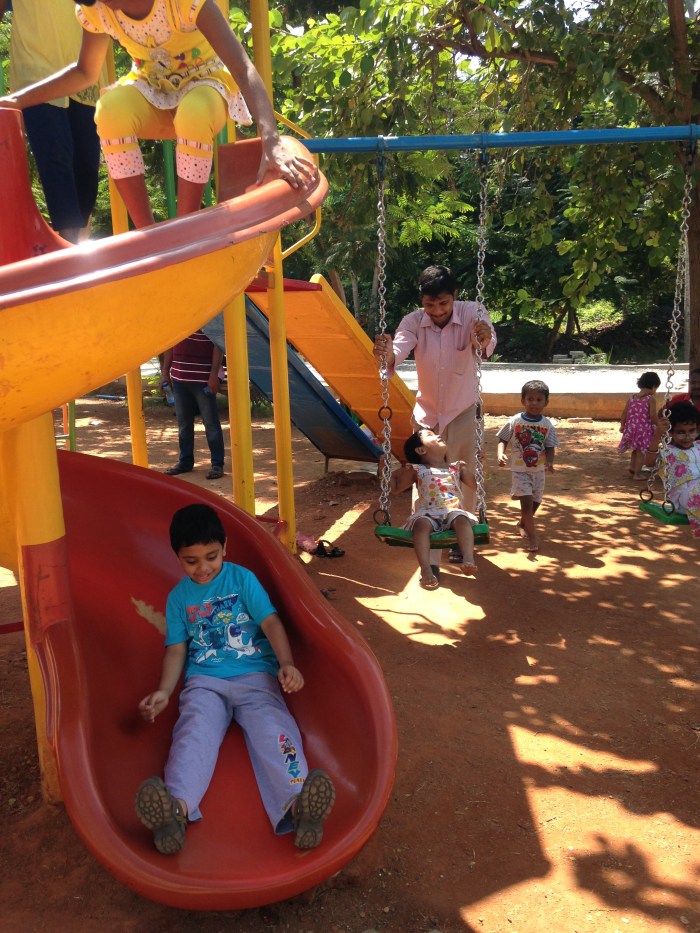
Perseverance : I have seen kids go up and down the slide multiple times till they succeed. I have never seen them give up in life on anything. Why do we as adults tend to give up even before we give things a try ? Kids have the patience and the perseverance, which we need to learn. As we grow up our patience fades and so does our perseverance. We end up making simple things complicated and thus give up even without a try.

It may be worthwhile to observe the kids around us and learn management from them. The lessons are practical and real life. We can refresh our knowledge, skills and attitude to life. What do you think ?

S Ramesh Shankar