Fashion is cyclic

Fashion is cyclic and so is life. I was once asked in my college viva as to why fashion is cyclic ? I did not know the answer and responded that it may be because the world is round. Later when I clarified with my professor, he said I was partly right. He said fashion is cyclic because the choices are always limited for everything in life. Once we reach the limit , we tend to follow a repeat cycle.

We can examine this hypothesis from different angles. Let us first look at fashion itself. If we take hairstyle, we have the option of having long hair, medium, short hair or no hair and then we revert to long hair. If we look at our pants. We had tight fitting pants, bell bottoms, parallels and then we may revert to tight pants. So, we notice that all aspects of fashion is cyclic.

If we examine this from HR practices in an organisation, the story is not very different. If we look at rewards and recognition practices, we had high level of differentiation and focus on individual rewards. We then moved to a hybrid model to balance individual and team rewards. Finally, we denounce individual differentiation and feel that the best way to go is team rewards. The story of the bell curve is testimony to this theory as well. Today the same organizations which kept bell curve as the way to differentiate performance assessment have started moving away from the same.

Now, let us look at life. As they say in common parlance, life has come a full circle. We go through bad times and after years of struggle, we feel we have got over the ridge and some good things start to happen. As we ride the crest, we again see the clouds of trouble approaching us. Life is never a straight road. It has a lots of twists and turns and it is up to us to develop the resilience to deal with the uncertainties of life.

Even nature teaches us the cycle of life. We have a great monsoon and a bumper crop for two years in a row. We feel the world is green and food and commodity prices drop. Then we have a severe drought and huge losses to farmers. This is followed by high inflation and escalating food prices. The following year again we have a normal monsoon and life seems to limp back to normalcy.

One of the lessons I have learnt in life is that it is unpredictable. You face a trough, when you expect a crest and vice versa. One has to develop our patience and perseverance to deal with ups and downs. Our ability to bounce back and deal with both with equanimity makes us a winner in life. We need to realize that there is always a sun rise after every sun set. Hence, there is no need to despair after a trough but be optimistic that a crest will soon follow.

Every thing in life goes round and round. We have to develop the ability to be comfortable with the circles in our life. It is a continuum and for every dark and cloudy day, there will be a bright and sunny day that follows. If we develop the ability to deal with the breaks in between, we become victorious in life. It may look that the dark and gloomy days never end for us. The sun looks to never shine for us. But, herein we need the patience and the gratitude that we are better off than millions of people around us in the world.

Life is a full circle like in the floral decoration of the photo above. Let us learn to deal with it.

S Ramesh Shankar
Joy of giving…

I have always be in awe of our festivals in India. Diwali is no exception. Apart from lights and crackers, one recalls Diwali with fond memories because the entire family got together once in a year and celebrated together. We got up early at dawn and had an oil bath before sunrise and enjoyed all the sweets and savouries all day.

Today I got a new insight on Diwali. It is celebrated in India with two different beliefs in the northern and southern part of the country. In the north, people believe that Lord Rama returned to Ayodhya after his 14 years in the forests and hence is welcomed back with lights and crackers. In the South, it is believed that Lord Krishna killed a ghost by name Narakaasura on this day in Dwaraka Yuga.

The new insight I got today is from a forward about the story of Narakaasura and the lessons for all of us. It is believed that Narakaasura is the “I” or ego residing in all of us as humans. When Lord Krishna killed Narakaasura, he eliminated our ego and released more than 16000 evils in us. So the next day on amavasya we pray to Godess Lakshmi to lead us to the right path.

Every ritual in Hindu religion and so in other religions has a deep insight for all of us. We generally get swayed by the rituals and start believing that they are of no use and most of us including me give up rituals because they serve no human purpose. I have been no exception. Now that I have all the time in the world, I am able to reflect and get new insights into these rituals.

Another interesting belief that we should clean our home and get rid of all the unwanted things. This is also symbolic that God wants us to give up all that is not necessary and take up the good things in life.

It is also enshrined in our religions that the best way to serve God is to serve the human kind. If we give more, we get more. If we are content with what we have, God always gives us more than what we need. This is the challenge for all of us. How much is enough – is a question difficult to ask and answer for oneself ?

I have admired people who give away without expecting anything in return. Recently another friend forwarded a message with a great insight. It was a couplet from Rahim. When Tulsidas looked at Rahim donating, he found his eyes looked at the ground and so asked him ” O great person, where have you learnt this amazing way of giving ? “. As your hands rise ( to give), your eyes look down. “. Rahim replies – “. The Giver is someone else ( God Almighty), giving day and night. The world has a misconception that I am the giver. So, I lower my eyes in embarrassment. ”

The best people I have met in life are those who give unconditionally. They are anonymous most of the times and recipient does not know that they are the donors. They give because they have a surplus and they are grateful to the Almighty for it and want to thank him for the generosity bestowed on them.

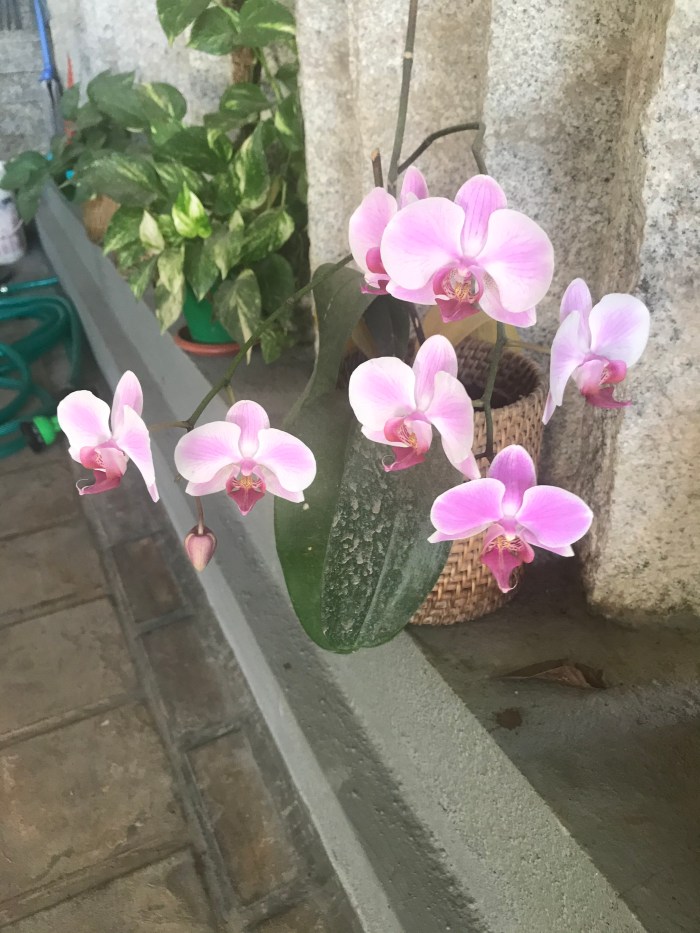
It is like the exotic orchid in the photo above, given my colleagues at work, which are blooming because of their unconditional love.

This blog a salute from my side to all the wonderful people who have made me what I am today. They have given me support, advice, money and love unconditionally. I can never ever return their favour in any form. I promise to give back without expecting anything in return as I bow in gratitude to them.

S Ramesh Shankar

27th October 2019

Social distress

What is the root cause of stress in society today ?

My hypothesis is the disintegration of “family” as a social institution. In India, family was the foundation of the social structure in society. It was the strongest of social institutions and mostly extended beyond the nuclear family into a joint family. Apart from brothers, sisters, uncles, aunts staying together, the neighbourhood also provided a natural extension to the concept of family.

Modernism and technological evolution has provided more wealth and convenience to human kind. However, it has also led to large scale migration of families from villages to cities and towns in search of better career opportunities. This has led to disintegration of family as an institution. The breaking of the joint family means that the kids of today do not have a social cover of the family and the extended family any more.

This gets further complicated by dual income families. This means both the spouses work and the kids are brought up in crèches and with home nurses or maids. This is inevitable in a city landscape and this means that the growing child depends more on the social support of these individuals than family members. Both parents need to work to maintain a sustainable living in an ever increasing competitive environment around us.

This leads to parents ability to spend less time with their children and thereby provide the necessary social and psychological support. This is then substituted by mobile phones, tablets and the television for support. This in turn leads to avoidable and sometimes undesirable influences on the minds of the children. Children get addicted to watching movies and playing games as they are not used to dirtying their hands in sand in a park any more or playing with other kids.

Many children enter a pre-school even before they are three years old as parents want to shift the daily care to a pre school as they neither have the time nor the patience to invest in them any more. This could be genuinely due to lack of time or for convenience. Either way, the children grow up in pre-school much before they deserve to be there. This leads to peer learning and habits, which may not be desirable or ordained by their parents in the normal course.

These kids growing up as millennials join organisation as employees. They are more sensitive for their age and depend on social media for all their socio-psychological support as the family has disintegrated and friends are virtual and not real any more. This leads to anxiety and stress which in turn leads to smoking, drinking or drugs when they are not able to cope with the same.

Thus “Social Distress” is a phenomenon evolving in society today. It is a complex phenomenon emanating from breaking of family as an institution and then the disappearance of real friends in society. It is time to realise that mobile phone and social media cannot be a real substitute for social and psychological support in real life. It is time to realize that technology should lead to better quality of human life and not the other way around.

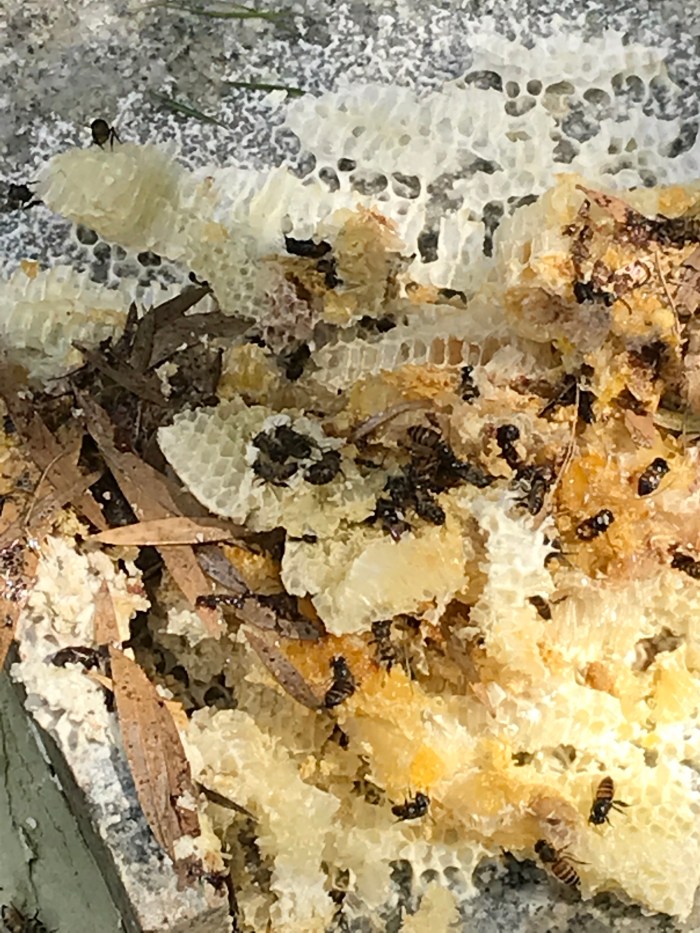
The bees always remain in a well knit family. If they are disturbed as in the photo above, they are in social distress.

It is time for us to strengthen relationships all around us. It is time to spend more time in the family with our children. It is time to socially engage with family and friends in the real world. Social stress can be tackled in the real world only by strengthening the quality of all our relationships.

Time to wake ups is today.

S Ramesh Shankar