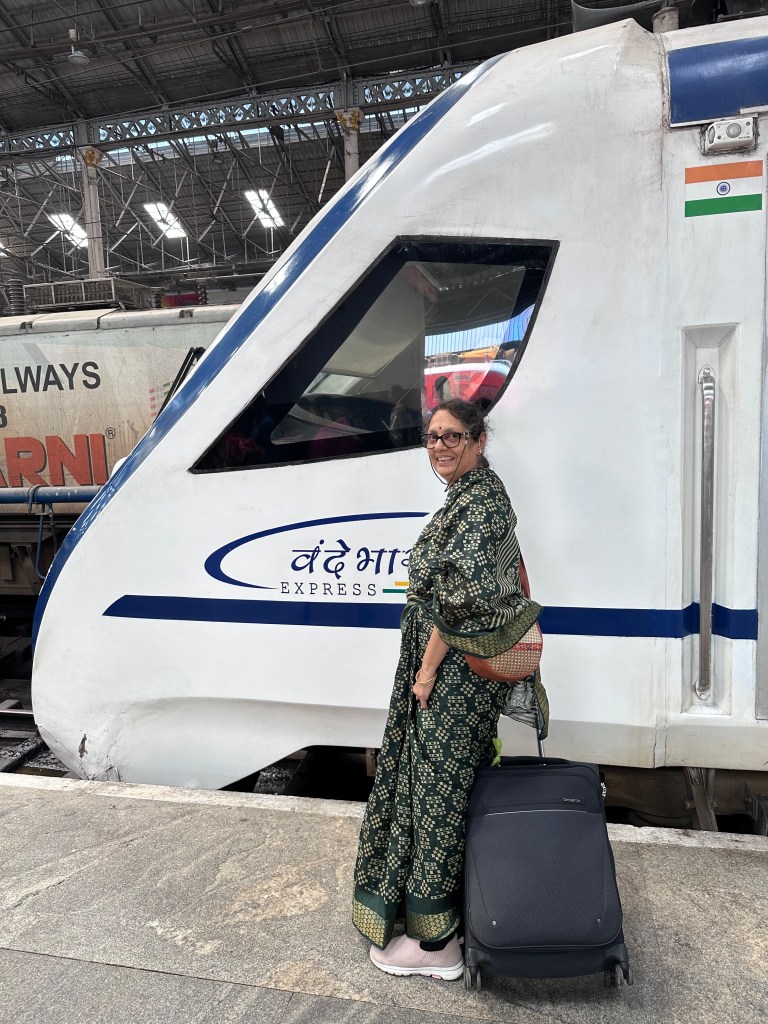
When you want to make a home, you have to leave your home

I was watching a music reality show on TV and one of the judges mentioned in Hindi – “ Ghar banane ke liye, ghar chodna padta hai “. If translated, it literally means that “If you want make a home, you have to leave your home”. Although translations many a time do not convey the real meaning of the quote, it is very insightful.

If you want to make a mark in your career, you have to leave the comforts of your home. Many of us grow up in small towns, villages or even in cities but never like to leave them since we get attached to our family, friends and the ethos of that place.

I hail from Chennai in South India. We used to have a joke in my college days that if you have the courage to cross Basin bridge station ( the station next to Chennai Central station), your mind will broaden. I have experienced this and agree with this world view.

We may pursue any career in life. We could work in corporates, run our own business or become a professional sports person. It does not matter. We may be able to excel in whatever we do ,the day we venture out of our comfort zone.

Even as students, we tend to study in the same town or city, where we have grown up as a child. We resist moving out of that city or town, even to pursue higher studies. This makes us like a frog in a well. However, if we get over this inertia and move out of our city of up- bringing, to pursue higher education, our mind broadens and our learning multiplies.

This is equally true at the work place. Many employees want to learn and grow in the city or state ,of their origin. When faced with a transfer, even on promotion, they resist and give some excuse to stay back in the city of their birth or up -bringing.

In my view, this could become a limiting factor ,in their career. We learn not only from the role we play in the organisation but the environment around us ,too. The teams would be different, the culture and ethos of the new city or town ,could open our eyes and tickle our brains.

I can state with empirical evidence of my own experience of living and working, in ten different towns/cities ,that my world view has grown and evolved ,because of these multifaceted experiences. If I had lived and worked only in one city, I may have evolved as an uni-dimensional professional. However, these experiences made me learn and adapt to different environments and learn from one another.

I have seen this in my children too. They have also lived, studied and worked in different towns/cities and this has made them adapt to different cultures and professional environments. Today, they can thrive in any scenario because they are not limited ,to live and work ,in one environment.

Life is a never ending learning journey. The more we spread our experiences and environments, the more we learn. The pandemic has further necessitated the need to learn and adapt to different situations at a short notice or no notice at all.

Let us learn to re discover ourselves everyday.

S Ramesh Shankar

24th Dec 2024
Career planning versus Succession planning

One of the questions many employees generally ask is to understand the difference between career and succession planning in organisations. Career planning is for individuals whereas succession planning is for key positions in the organisation.

Let us look at career planning first. Every individual, who joins an organisation wants to climb the corporate ladder. Everyone aspires to reach the highest level possible in the organisation in the shortest possible time.

How do we do career planning ? Career planning is to be done by individuals, managers for their team members and HR for key people in the organisation. Who is ultimately responsible for career planning ? In my view, the individual employee has to take the ultimate responsibility of planning their own careers.

It is like an aspiring sportsperson. We recently saw the world chess champion emerge from India. This young boy at the age of 7 dreamt of becoming the world champion and worked towards it by dedication, commitment and a lot of hard work. He was ably supported by mentors and coaches to realise his dream goal.

Similarly, in the organisational context, every individual needs to have a dream. An aspirational goal to achieve in their own careers. This could be long term, medium term and short term. Once the goal emerges, the individual needs to plan their steps to achieve that goal. The individual’s manager and HR partner could support them in identifying the steps and developing the capabilities to achieve that goal.

The manager has the responsibility to enable career planning of her team members. While the individual should be made ultimately responsible to steer their careers, the manager can be an invaluable mentor or guide in this process.

Human Resources partner can be the facilitator of the process. HR can help the individual and the manager to identify the steps to the goal and also the capabilities required at different stages of the individual’s career.

On the other hand, Succession planning is for key positions in the organisation. This is primarily the role of HR and senior leadership in the organisation. HR needs to identify what could be the key positions in the organisation which are critical. A simple method is to start with the top two levels in the organisational hierarchy and then look at other key positions.

Once positions are identified, HR along with leadership needs to define what are the key capabilities to effectively play those roles. Then identify whether we have suitable people within the organisation, who can be groomed to play those roles. If not, identify people outside the organisation, who could be inducted so that they can be developed as successors for key positions.

To summarise, career planning is for individuals and every employee has to take responsibility for their own careers. They need to be supported by their managers and HR to evolve the steps, develop the capabilities and move towards their career goals.

On the other hand, succession planning is for key positions. HR & leadership have to identify the key positions, the capabilities required for those positions and also the people who can be groomed to take over those positions in the future. This could be from within or outside the organisation. Further their development to make them ready to take over these roles in the future needs to be planned and executed.

Career planning is for individuals and succession planning is for key positions.

S Ramesh Shankar

23rd Dec 2024

Advice givers are many, advice takers are few

I was recently watching a music reality show on TV. One of the judges of the show said – “ Advice givers are many, advice takers are few”. This is true. Our parents, teachers and elders have given us valuable advice right through our lives but most of us have hardly heeded to those in our lives.

This is the reality of life. We may have many people around us who are old and wise or young and wild, who give us valuable tips in life but we ignore them. However, when a young person is willing to take your advice and work on it, it could change their life.

In this very episode, a famous music director shared his life story and said that when he went for an audition of a music reality show, one of the guest judges had advised him to improve his pronunciation and diction in a particular language.

This young aspirant did exactly that and today he has grown into a successful music director and earned a command over that language, where he is in a position to guide others and improve their diction and pronunciation.

In life, we may get advice, left, right and centre from people all around us. It is upto us to take the advice and work on it. If we think, that advice would be helpful to us, we can convert a weakness into a strength by working on that advice.

Most of the times, we listen to advice and forget about it. It is like the feedback we get from people all around us. It could be our family, friends or even colleagues at our work place.

If we take the feedback seriously and the advice to its logical end, we may benefit more than we may lose. It is like a coach’s advise to a sportsperson. If the sports person takes the advice early in their life and act on it, it is possible that they become champions. On the other hand, with all the talent in hand, if we neglect advice, we cannot blame anyone else other than oneself.

Life is no different in reality. It is important to remember that advice may not necessarily come from elders or more experienced people in our lives. It could be the younger members in our team or our own kids. It all depends on our maturity to accept advice from our hearts and act on them. If we do, we improve and if we don’t, nobody else gains from it.

In life and work, we may not get advice all the time. If we ignore valuable advice, even our well wishers may stop giving advise it to us. Like the famous quote in the Mahabharata called “Vidhurshastra” – “ you never give advise to an adult, unless asked for “. This might become a reality for us if we do not take the advise given to us as kids or youth as people may refrain to give advise to us as adults.

None of us are perfect. So, we need to get advice every day of our lives from people, who are better than us. If we are willing to listen and learn, we gain and if we do not, we lose.

Let us evolve as “advise takers” from today.

S Ramesh Shankar

14th Dec 2024