Role Reversal


As we grow up as kids, we all are in awe of our parents.  We adore them and think they are everything to us.  We respect them, serve them and even role model their behaviour in our everyday life.  They become the standard for most things we do in life.  We consult them and seek their advice in any dilemma or major decisions in life.  This continues till the day we stand on our own feet.  

As we become independent, we start believing that the world is in our control.  We may not disrespect them but tend to take decisions on our own.  Our parents are proud of our independent nature and they let go their control over us.  We gain confidence and lead our own lives in our own way.

We get married and our spouse enters our lives.  She/He contributes equally to our well being and participates in all our decision making processes.  Some of us continue to seek advice from our parents even at this stage as we respect their acumen.  Then we bear kids and many a time move away from our homes in view of career compulsions.  This not only makes us physically away from our parents but also tends to emotionally distance us.

Our parents continue to believe that we are connected with them emotionally and we will take care of them for the rest of their lives.  But suddenly, the pressures of work , family commitments and the demands of our careers takes us farther away from them.  They are left lonely at home and mostly to fend for themselves.  Many a time , as children, we do not have the time or the intent even to visit them leave alone take care of  all their needs.

Suddenly, our parents feel the vacuum in their lives.  They feel helpless and not taken care of.  They do not look upon us for our monetary support.  They are more interested in our emotional support.  We think we have done our duty by sending some money every month or by providing a lot of material support for their physical convenience.  We do not realize that at this stage of their life, they look for emotional well being rather than material comforts.

I have always wondered why this change as the roles reverse in our lives.  Why do we not realize that this is a cycle of life and one day we will be in their position too.  What happens to all their contributions to our success in life ? Why do we become less grateful to them ? Why does selfish interest make us forget to be grateful to our parents, who have made us what we are today ?

May be I do not have the answers but I do have many questions.  May be I can be different now and in the future.  What can make us realize that this is the core of the Indian culture.  How can we sustain and preserve it for our future generations ? Can I commit to be different and be a role model for my children and grand children to follow ?

Even today, there are many good people, who take care of their parents( like my aunt in the picture above taken care by her son and daughter in law) and I salute them.

S Ramesh Shankar

Patience Pays


Is patience necessary in life ?  I am not sure but I am willing to examine it.   I recall I was a short tempered guy when I grew up.  This made me impatient in life.  I was not happy at my own pace of doing things.  As I ventured out of home and got into work, I realised that my impatience turned into anger.  I lost my cool at silly things and wasted more of my energy than others.  This made me less productive in life.

If I then move to the work place, I observe that all of us are in a hurry all the time.  We are competitive and hence want to outdo our colleagues each and every time.  We take up more than we can chew at work.  We want to prove that we are smarter than others. We are impatient for results every day.

If we move to our families, the situation is not different.  We want our children to grow up fast as we cannot deal with the tantrums of kids.  As children, we want to grow up fast we want to stand on own feet.  As newly married couples today we are so impatient that we are not ready to wait for nine months to have a kid and are willing to adopt or go for alternate methods.

What does all this teach us in life ?  It tells us that we want the results without investing in the efforts.  We want to win the game without playing the game.  Imagine winning a football match without playing for ninety minutes. We want to be the CEO within days of our joining the organisation.  If we feel, there is less chance, we want to start a start up so that we can become the CEO from day one.

All this implies that today the end is more important than the means to the end.  While Gandhiji said that ” The means to the end is more important than the end itself”.  If someone quotes Gandhiji to us, we may get impatient.  We may even say that this guy is outdated.  He needs to take a break or retire from work. I do not blame anyone for this since each of us are to blame ourselves.

If I look back, I realize that “patience pays”.  I have no doubt that if you put in your best, you will get the best.  The Japanese have always taught us that “fix the process, not the problem”.  We need patience to perform.  We need patience to be the best.  We need patience to excel.  We need patience to evolve as a good human being.   Some may turn around and say that one may realize this after one goes through a life of impatience.  It may be true for some and not for others.  Life teaches us many lessons along the way as we go through many events.  It is up to us to learn and become patient. Alternately, learn it late and be patient till you learn.   The picture of the two birds patiently waiting to catch the fish in the lake explains why patience pays.

The choice is always ours.

S Ramesh Shankar

“I can” or ” I cannot”

IMG_1666Many years ago I met a senior consultant who taught me an important lesson in life.  He told me that everything in life can be answered with “I can” or “I cannot”.  Once you decide you can, you find all the ways and means to do it and once you decide you cannot, you find all the excuses not to do it.

It looked a bit simplistic to me.  But, I am happy I got this lesson, when I was just starting my career.  I believe it is true and it works for me.  I am a born optimist.  So, for me, if I believe I want something, it is always ” I can”.  I have very very rarely felt – ” I cannot”.  This is true for my personal as well as work life.

I can cite many examples from my life, which has established that this is true.  I will share a few of my personal ones .  Then, I will also share a few of my life experiences, where I have met people, who believe they always can and also met people, who believe they always  can’t.

My first example was when I wanted to plunge into the professional world to prove myself.  I started my career in a public sector undertaking as a management trainee and worked there for 14 years successfully.  Life was cosy, learning was good and my career progressed pretty well.  I got promoted every three years on an average and also got a job rotation every 3rd year.  But, when I got my last promotion in 1995 as a Senior Manager, I asked my manager what would be my new role.  When he replied that I will continue with my present role even after my promotion, I decided that I need to move on and prove my worth in the market place.  I took a plunge in the private sector without knowing what is in store for me in the world outside.  It was 1995 and the job market was not as rosy as it is today.  But, I felt “I can” and took the risk much against the advise of my manager and my organisation.  Today after 21 years, I have no regrets.  God has been kind to me and I have realised my potential in a competitive market place since I believed ” I can”.

The second example could be from my personal life.  I decided to go on a long road trip.  I had never done it before and had no experience of it.  But I believed “I can” and then I made it to cover 7000 kilometres on road with my family in a small car across India.  I planned for it, collected maps, prepared my family and took the risk.  It was about facing challenges but when my family members were supportive, there was no way I could not do it.

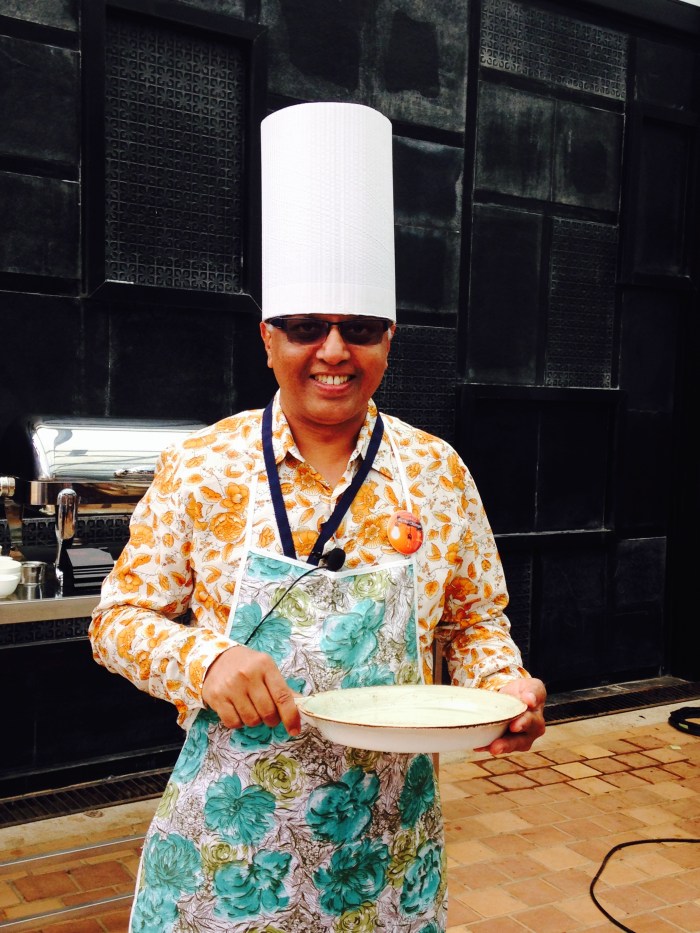
I have never really cooked in my life.  But, once when we were challenged to participate in a cooking contest.  I jumped in and our team won the first prize.  I believe it was partly because I thought I always could.

I have met people in life who will never say no to anything.  They can always find a way to do anything.  Sometimes, it may take more time or more effort but “No” is not in their dictionary.  On the other hand,  I have met people, who will say “Not possible” even before understanding what they need to do.  Such people will have excuses for everything.  I have met a few team members at work, who will shirk work even without understanding how it will benefit them.  They may even go to the extent of saying that it is not within their scope of duties.

I recall an incident way back in the nineties.  I had been for campus recruitment to an engineering college in Patiala. Whenever, I visit a place for the first time, I love to see the around  and buy some unique thing from there.  I met the placement officer and shared my interest.  He said, yes you can.  I told him that my selection process will start at 8 am and finish by 9 pm.  Then, how could I see the place ! He said no problem, you can.  I told him even if I cannot see the around the place since it would be late at night, will it be possible to buy some unique item as a memorabilia.  He confirmed again that I could. When I enquired how I could buy something after all the shops would shut by 9 pm .  He said he will ensure some shops are kept open for me.  Then I said, I may miss my train if I do shopping, for which he said I will arrange a cab to drop me back to Delhi.  He had options for every contigency since he believed “he can” always.

Life is full of possibilities and we can make things possible if we want to.  However, if we decide to give up in our own mind, then even the possible looks impossible.

Make your choice and convert the impossible to possible by saying – ” I can”

S Ramesh Shankar