Expressions…

“Face is the index of the mind” is an an old saying. It is more than true. There is a lot of research to confirm that more than 70% of human communication happens through non verbal means. This means our expressions speak more than our words.

The best opportunity to learn from expressions is from the kids. They can express the entire spectrum of emotions of the human kind in more ways than one. None of us need to learn to speak to a child to understand their emotions. However, as we grow up we tend to forget to express ourselves

Alternatively, we are conditioned by the environment around us and our own belief systems that expressing oneself is immature or childish. In my view, this may be the beginning of the end of joy in our lives. A child emotes without any reason. Children express in every way they can. Emoting oneself appropriately not only may secrete good hormones in the body but keeps you happy always.

If we look back, our childhood was the best period of our lives, when we unconditionally expressed ourselves. As we grow into an adolescent , we tend to restrain ourselves, which then results in rebellious behaviour. Growing into an adult we stop emoting altogether. We think it is not mature enough to share our emotions with others.

The “adult” in us over rules the child. Every time we feel like laughing, crying or screaming, we regulate our behaviour to try to do the opposite. This may sometimes end up in awkward reactions in different situations. For eg. we may laugh when we are supposed to cry or the other way around. This is because the world around us conditions us on what is right and what is wrong.

The right and wrong emotions are not determined by our heart as it should normally be but how people react around us. If people may laugh at our crying, then we do not. If someone objects to our laughing we tend it to keep it ourselves.

We need to challenge ourselves. We need to live our emotions the way we want to. People who emote unconditionally are the people who have no blood pressure. If we forget to share our emotions, we may forget to cry, laugh or get angry.

If we condition ourselves too much, we may to tend to contradict ourselves. Our emotions will not reflect our true feeling inside. This may be easily be misunderstood and we may end up in conflicts with others around us.

It is time to rekindle the child in us. It is time to express ourselves the way we want to. Let us not be be guided by the reactions of others. Let us be guided by our own gut feelings. We need to learn to be true to ourselves. This may be the best way to live life fully.

Let us interact with children around us and learn from them. It is never too late to learn. Every child can teach us to live life the way we need to live. So what if we have forgotten the basics of life. It is time to look back to move forward sometimes.

Let us learn to express ourselves.

S Ramesh Shankar

15th Oct 2020

Blame the world

One of my seniors taught me early in my career that I should speak in “first person singular” and encourage others to do so. When he first told me so, I was perplexed as to why he was saying this. It took me sometime to digest this simple message and then internalise it.

His advise was that I should take responsibility for what I am saying and doing and hence I should speak in first person singular and never in third person. We generally tend to speak in third person and blame the world for all the wrongs we have done or are experiencing in life.

If we look a bit within, we realise that we need to take responsibility for our lives and cannot blame the world for our state of affairs. While it may be difficult to understand and assimilate this simple axiom in life, it is worth learning it as we go along in our life and career.

Today I strongly believe that my state of affairs are all because of my actions or in-actions as the case may be. If I am successful in life, I can take the credit for my hard work apart from a bit of luck favouring me. If I fail, I equally have to take the blame and not pass it on to anyone else around me.

In organisations, it is quite common to see many leaders taking the credit for their team’s success and blaming their team members for their failure. A true leader will always do the other way around. She or he will take the blame for the team’s failure and credit the success to the team.

Another interesting dimension in the organisational context is to enable employees to speak for themselves. I also learnt this simple truth from one of my seniors. He had told me that we need to encourage employees to speak for themselves. Let them come to us and ask a hundred times -“ Why I cannot be promoted ? “ or “Why my increment is low ?” . This is fine and should be encouraged. However, the moment they ask “Why I cannot be promoted when X has been promoted ?”, they should be reprimanded. We need to tell them that they have every right to speak for themselves and not for others. When they speak for others, it is gossip and that needs to be discouraged. This is the culture building in organisations. It was an invaluable lesson in my career.

This simple truth can be extended to family and life in general. We need to encourage our children to come to us and complain about issues they face themselves and not about others. The moment we are able to establish and internalise this simple truth, our life will be happier and it will be easy to deal with issues both within the family and in society in general.

We can extend this simple principle to states and even nations at large. Every state can ask the centre as to why they have got less allocation of funds or why they have not got more central projects etc ? The moment a state compares itself with another state and then demands more grants etc, it needs to be pulled up.

Life is all about taking responsibility. We need to take full ownership for our lives and be accountable for the efforts and the results will follow. If we blame the world for our failures, nobody is going to listen to us and we will continue to be a failure in life.

As in the photo above, I need to take responsibility for not only how I look but for all my actions.

Let me resolve today that I take responsibility for my life and cannot blame the world or anyone else for my success and failure.

S Ramesh Shankar

29th April 2020

The sound of the river

Siruvani river

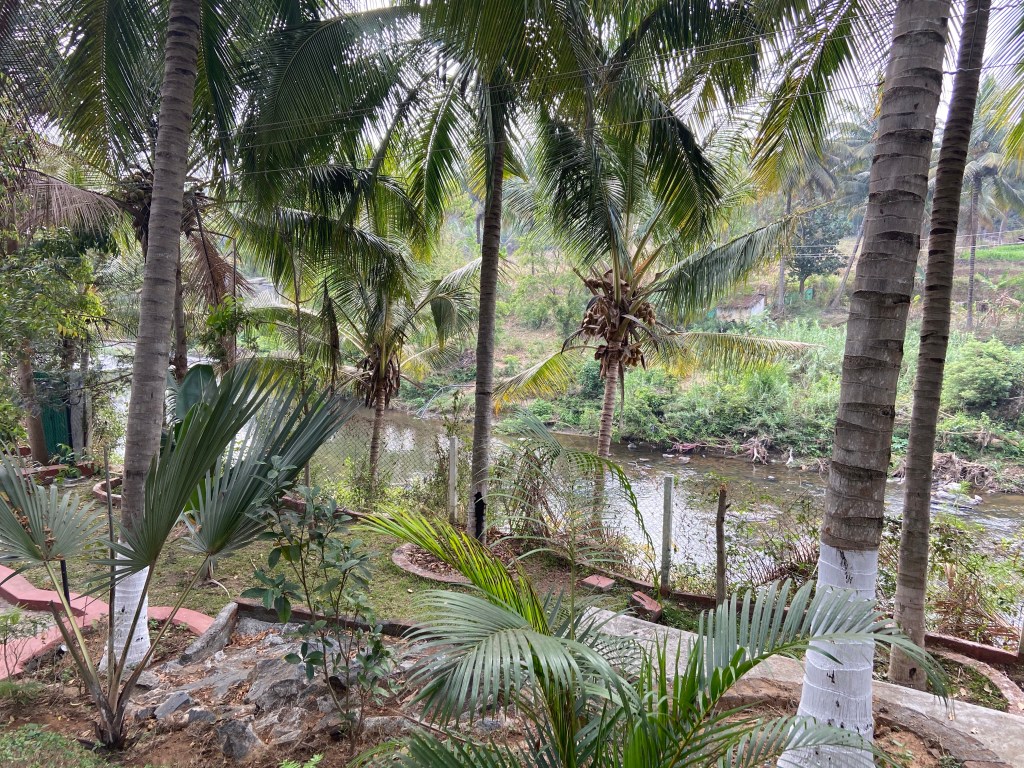
I came for a short break to Anaikatti on the outskirts of Coimbatore bordering Kerala. I did not realise that the resort I was booked was on the banks of the river Siruvani.

On reaching this place, I got a room facing the river. This is not only scenic but the gurgling sound of the flowing river soothes your mind, body and soul. You forget the material world around you and sink into the soulfulness of nature.

It is green all around you surrounded by coconut and arecanut trees. As you watch the river from your room, you feel a sense of calm. It flows steadily and without any catalyst. This made me think why we need a push all the time in our life.

A river can possibly teach us a lot of life lessons. First and foremost it goes around its business without any fuss. It flows through the hills, forests and plains and does not look at stones, girders or hills as obstacles on the way. It considers flowing through them as part of its journey to reach its destination.

The crystal clear water of the river signifies that we can be pure at heart even if we are surrounded by people we may not adore. Most of us throw all trash into the river as it flows by but the river purifies itself and flows clear along its way. It not only provides water for drinking, bathing and other ablutions, it also cools the environment around it as it passes through its way forward.

A river never stops on its way. Have we ever heard of a river, which stops mid way. Never. It surmounts all the obstacles on the way and moves forward all the time. We get immersed in life and get drowned and pulled down by obstacles. We wonder whom to blame for all the things going wrong in our lives.

A river shares its resources without expecting anything in return. It provides water for drinking, transport, washing and many other uses and does not expect us to pay back. On the other hand, we as humans expect more in return even for the smallest service we provide to others. It’s time to learn to be selfless from the rivers.

As the river flows down its path and merges into a bigger river or into the sea, it does not cling to its identity. It is willing to give up its name and fame as it merges into its final destination. We as humans are not willing to subsume our ego for the larger good of society. “I” is the centre of everything we do and we want to take credit even for things we may not have contributed much in life.

I was fascinated by the qualities of the river flowing in front of me. It taught me invaluable lessons of moving on without blaming obstacles on the way, sharing resources selflessly and working for the larger good of society by subsuming our egos.

It is time to reflect and learn from the rivers around us.

S Ramesh Shankar

5th March 2020