Maturity versus Immaturity


One of my young colleagues asked me where does maturity end and immaturity begin ?  It is difficult to answer.  He was shocked at his interactions with one of his key stakeholders.  While it started off very maturely and informally, it ended with a bad taste in the mouth and a sense of immaturity. So, the question is ” where does immaturity begin and maturity end or vice versa ?” 

When you interact with someone senior, you assume that the person will be more mature than you.  Maturity is relative.  It has to be experienced to be believed.  Age and experience does not necessarily guarantee maturity in anyone.  I have met a lot of young students and aspiring professionals, who have displayed exceptional maturity.  On the other hand, I have met senior professionals, who are yet to mature.

So, how does one deal with immaturity ?  In my view, maturity is a state of mind.  It has to evolve for a person.  Some of us gain maturity early while others take more time.  It is our ability to adapt to different kinds of persons and their relative level of maturity that makes us successful.  We may sometimes take light hearted humour as informal.  Then it may lead to informal interactions and then when one fine day informality is misunderstood by the other person, it hurts us and is termed as immaturity.

Does it mean that we should avoid informal interactions ?  I would not say so.  I always believe in creating a work environment, where informality prevails.  We should not only be physically accessible to our team members and colleagues but also mentally and emotionally at all times.  However, we need to learn where to draw the line.  It is easier said than done.  One needs to learn by experience where informality ends and formality begins.  It is a very thin line and we are bound to err many a time.

So this colleague asked me –  “How to deal with the immaturity of his key stakeholder?”. One needs to gauge the behaviour of others and learn to draw the line.  The line is not dependant on age, experience or seniority.  It is based on relative maturity.  One learns to draw the line by experience and most times by facing the consequences.  It is painful at times but one learns by facing it in real life.

I have seen this phenomenon at work and even in personal life.  It happens in the family and society as well.  We find unpredictable and irrational behaviour by very senior people.  It is difficult for youngsters to deal with them.  On the other hand, we find very mature and competent young people who wear maturity on their shoulders even before they gain enough experience.

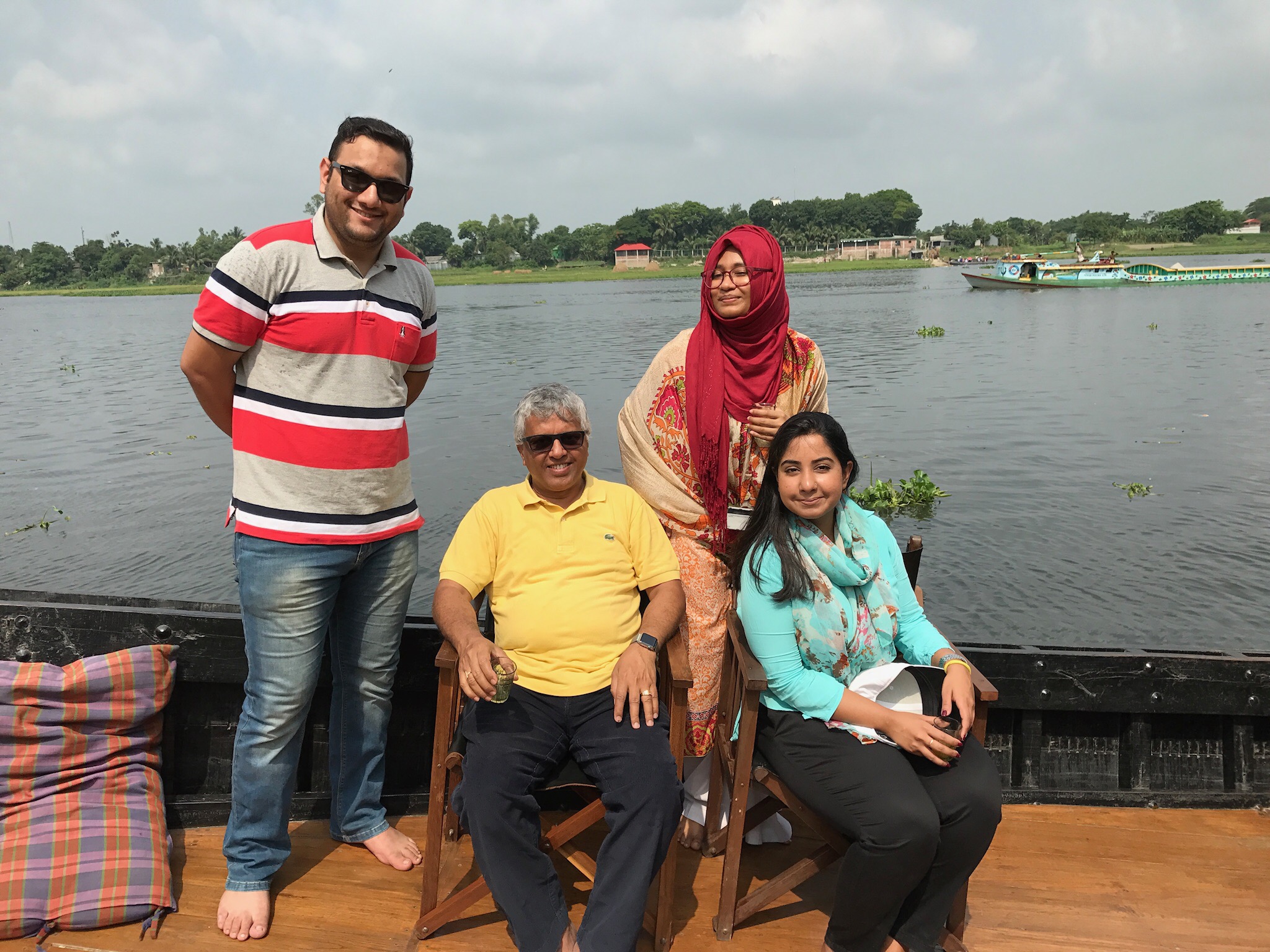
I had a lot of questions from these young colleagues (as in the photo above) during a recent team building workshop on a boat in Bangladesh.

My learning in life is to moderate yourself than attempt to moderate the other person.  It is not easy for us to mould the behaviour of others.  It is easier to adapt our behaviour to suit the style of the other person.  As I said earlier, failure may be the stepping stone to success in many situations but there is nothing wrong with that too.  After all every sportsperson wins after losing many games.  Further, no sportsperson gives up after losing, even though the road to victory may be long and ardous.

Lets us begin the change today.

S Ramesh Shankar
Simplicity

IMG_0148
I have always been impressed by the simplicity of the villagers.  I recently had the opportunity to visit a village on the outskirts of Dhaka and the experience was the same.  We were on a boat with our team on a team building exercise.  The organisers informed us that there was a village on our route along the shores of the river and if we were interested we could stop by.

This was a village of potters.  We stopped by and some of us ventured into the village.  As we landed, we were welcomed by a group of old villagers sitting on the bank.  They were clothed in simple muslin and were just relaxing on the shores.  They welcomed us with warm smiles and made us feel special even as we landed.  Then we went to the first hutment.  They were a group of artisans who were making a idol for worship for a religious festival in the ensuing months.  They not explained how they go about it but also were willing to share their idols for photographs.

Then we met a group of goldsmiths.  They were hand crafting silver and gold jewels.  They were happy to share their products and explain the process to us.  There was absolutely no attempt to hard sell anything to us.  They did not take undue advantage of a group of tourists to sell their produce taking advantage of our visit.  They were not at all disappointed when we did not end up buying anything from them.

The third hutment was a potter making pots for making yoghurt.  He explained how it was made and then fired in the kiln.  He further explained how it is marketed in the city. He also did not try to sell his pots to us but was more keen to explain the process of pot making.  This is unlike the city folk, who do not lose an opportunity to sell their produce even when we do not need them.

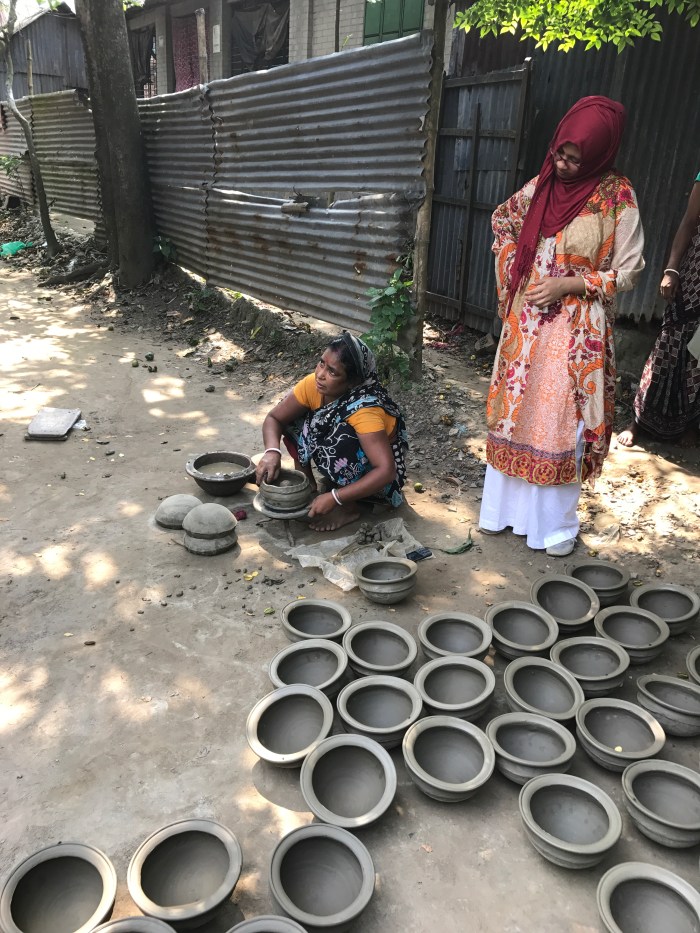
The last hutment was that of a lady potter who was actually making pots from mud through a manual process(as in the photo above).  When asked if a motorised process would have been more helpful and productive to her, she replied that she could not afford it and she was happy to do it the manual way.  She happily displayed how effortlessly she converted raw wet mud into a beautiful pot .  She then explained how it is dried and then heated in a kiln before is it cooled in sand and then goes for sale.

The best part of the trip was when this lady had kept some mango fruit dried up in a open mud plate.  When some of us enquired as to what was this used for ? , she explained the process of making dried mango papad.  She further added that it was taken by the villagers as a side dish and also helped in neutralising the summer heat.  She requested us to wait and offered us a sample of this tasty mango papad.  She did not accept any money from us as she said that it was just a small sample for us to taste it.

Such is the simplicity displayed by the villagers.  I am not sure if we get corrupted by materialism in life.  As we live in cities with all comforts of life, we forget the basic human values of life.  We are not interested in welcoming our guests.  We are not keen to share our knowledge or skills.  We guard our physical territories as if someone is always looking to invade us and attack us.  We are commercial in all our dealings and look for economic again in all human transactions.

It is time to wake up and go back to our roots.

It is time to learn “simplicity” from our village folks ?

S Ramesh Shankar

Blankness


I am not sure if this is a correct word in English.  But I am not worried about that as long as I am able to express what I feel.  There are some days when you are alone and feel that you are in a state of flux.  It is a feeling of emptiness and you think as if there is no meaning in life.  You also feel that there is neither a beginning nor an end to anything you do in life.  Is this a feeling some of us feel some time or the other in our life.  What do we do when this happens ?

The first good news is that we are not alone.  Many of us go through this in our life time.  Not once but may be many times. There is nothing to feel sad or disappointed.  It is like while undertaking a long road trip, you sometimes end up on a road, which is a dead end.  Neither your map works nor anything else.  Over and above there may be no sign of life anywhere around you.  The mobile network may not work too and then you wonder what to do.

If we end up in such a situation, what do we do ?  We do not abandon the car at that point and wonder what to do.  We reflect and contemplate.  Sometimes, we may retract our route and drive from where we came till we find a turn or a person to guide us.  Life is no different.  We have to pause and take a break some times.  It will look as if there is emptiness and we are in a state of vacuum.  It is ok to feel this way.  Just take a deep breath and may be a break and you may be able to restart life all over again.

I am reminded of the problems most of us face while using computers.  When the screen hangs and no key makes any impact, what do we do.  We either switch off and on the computer or press “Control+Alt+del”.  It is the same thing we have to do in our lives.  When we reach a dead end, we have to take a break.  We have to reboot ourselves and start all over again.  There is nothing right or wrong about such instances.  Interestingly many of us face such situations more often than not today in our lives.

This may happen in our career too.  We may feel we have reached a dead end and there may appear no light at the end of the tunnel.  There is no need to panic.  We need to introspect.  Are we equipped to deal with changing directions in our career.? Are we skilled to deal with the changing business environment?   Are we the best in whatever we do so that nobody can bypass us ?  If the the answer is yes to one or all of the above, we know what do do.

In case, we are still groping to find the answer, it may still never be too late.   If we cannot find the answer ourselves, we can ask our colleagues, seniors, family, friends or well wishers.  After all in life, we may have all the questions and it is human not to have all the answers.  If we did, we may not believe in that spiritual power, whom we may call God or by any other name.  Like in the photo above, if you are in a hot air balloon with a boat in the midst of the sea and do not know which side to row, what do you do ?

I am a born optimist.  I believe every question has to have an answer.  If we do not the know the same, it does not mean the answer does not exist.  We need to have the humility first to accept that we do not know the answer to our question in life and then the courage to ask the right person to help us.   Life is complex but the way to deal with it is simple.  When in doubt, ask ?

Is it possible ?

S Ramesh Shankar