Love….

IMG_0574
Love is the blood of life. It is to be experienced to be understood. One cannot express love in words easily. One can share feelings of love or experiences of love with others. Love has many forms as experienced by all of us. Let us examine love from various experiences in our cycle of life.

A child experiences love of the mother without even an exchange of a word. It could be sign or even touch, which makes the child feel love. The mother knows when a child is happy or sad. She can feel the emotions of her kid like no other human being can in her life.

As the child grows up as a kid, she is loved by everyone in the family. The young child loves her parents for some things and her siblings for other things. These expressions of love can be in the form of comforts in life or even a small help or favour. A pat on the back could be considered as an expression of love for the child.

Now the child grows up into an adolescent and love has a different meaning to him. He is attracted to the opposite sex and relates more to physical touch and feel. He lives in a world of fantasy and dreams of love in various forms in his life. He takes the love of parents and siblings for granted and is willing to sacrifice everything to win over the girl in his life.

As you grow into a young adult, this romanticised form of love grows more realistic. You start your work life and look at colleagues at work as partners to success. You do not live in a dream world. Your feet settles on the ground and want to make a mark in life and work and love is secondary at this stage of life.

Once settled at work, you plan to settle in life. Now one looks for a partner in life. The criteria for an ideal partner goes beyond physical looks and transcends to emotional and compatibility needs. You are willing to take your time to search for your ideal partner and are not in a great hurry. Love is a journey and not a destination in life.

Now you are married and consider your spouse as your equal. Each of us want to be an ideal partner and expect the same from the other. We try to put our best foot forward and live in a honey moon period till love lasts. As the feelings of love fades, we start finding fault with each other and do everything possible to find fault in our partner. It takes courage and humility of either of us to admit our mistakes and move on in life.

We then have kids and settle down in life. Our children bridge the ever growing gap of love between us and we get closer to each other – thanks to the bonding with our children. We realise our mistakes as we grow older and are willing to compromise and support each other at this stage of life. Love seems to connect us all over again as partners.

Our children finish their education and move on to their independent lives. The empty nest syndrome sets in and we realise that we need each other more than ever before. Love gets redefined at this stage of life. It is much more than physical. It is emotional, social and psychological bonding between us. We learn to support each other to experience love.

Love is cyclic. We almost become kids again as our grand children arrive in our lives. It is to be experienced to be believed. These tiny tots light up our emotions all over again. The child in us is re kindled as it had got buried deep inside us as adults.

It is time to experience love in every phase of life. Live and enjoy love as it evolves.

Love happens, it is never planned.

S Ramesh Shankar

25th June 2018

Anything new is good….

IMG_2118
All of us crave for new things most of the time. We like to have new clothes, new friends, new car, new house and et all. This habit develops as a child and continues possibly throughout our life time. While the saying goes “Old is gold” – new continues to enamour us. We may not have reasons to justify our behaviour all the time but we continue to crave for new things all the time in our lives.

Let us examine this behaviour from various angles. The first and foremost is the psychology of this behaviour. It may be due to boredom with existing things around us. It could be the belief that anything new would be better than the old we are used to. It may be due to our yearning for newer things in life. As the child grows up, we are fascinated by the changes in their behaviour. We clamour for a new word and new action every day and are overjoyed when it happens. I remember the first word my daughter uttered in her life. It was “Chidiya”(bird) and it was one of the most joyous moments in my life as a parent. She looked at a sparrow and named it as a bird the first time in her life.

Let us examine it from the lens of relationships. Most of us grow up in the secured environment of a family and get used to the relations around us. We look forward to establish new relationships when we go outside our homes in our quest for higher education or for jobs. We eagerly look forward to how every relationship will evolve. We put in our best efforts and look forward to a mutually rewarding relationship based on trust and mutual respect. This happens to us as individuals too. As bachelors or spinsters we lead a carefree life. Then we get married and look forward to a new relationship of equal intensity. We want to give our best and receive love in equal measure.

If we move to material things around us, the phenomenon is similar. We may have most the things we want in life. We still crave for new things on every possible occasion. We justify buying new things to changes in technology or our own needs. Sometimes, we want to upgrade our social status by buying more prestigious brands as we can afford them now. Every time we believe that anything new will be good for us. Our craving for new material things continues throughout our life journey. The only lesson one can learn is that if we can balance greed and need it may be helpful for us as human beings.

Now let us examine it from our own selves and how it adds joy to our lives. It can be different things may bring joy to different people. One may get joy buying a new pair of shoes although he has many pairs of shoes in his cupboard. It could be watches for some or handbags for others. I remember the first time I bought an expensive watch for myself, I felt guilty as I already had two watches. One of my colleagues also commented that all watches show the same time. This may be true but the joy of buying a new watch is not an experience which can be ignored. After all we need to live life that gives us joy every single day.

This craving for new things has to be within your affordable limits. We need to ensure that while we have every right to enjoy buying anything new in our lives it should not be at the expense of others or our own well being. Some of the ground rules I have been following in buying new things are – a. Never borrow and buy new things, b. Never sacrifice your well being to buy new things, c. Our craving for new things should not be at the expense of others d. Learn to donate old things when you buy new things so that your greed and needs are balanced.

As in the photo above, a new microscope is more fascinating for the kid than even ripe mangoes in front of him.

The joy of new things are to experienced to be believed. Joy for ourselves should not be at the cost of others.

What do you say ?

S Ramesh Shankar

Feel the hunger…

The other day I was playing badminton with a neighbour and he said he was a bit tired and wanted to stop after two games. I wondered what had happened to him as he normally had a good stamina. On inquiry, he informed that he had fasted the previous evening and hence was tired.

He further clarified that he was not fasting for any religious reasons. When further asked for the reasons, he hesitatingly said that he was periodically feeding children in an ashram and hence was fasting on that day. What really struck me is the reason for his fasting. He said he started fasting on every Thursday when the Ashram owner told him that it was not enough to feed the kids but may be good “To feel the hunger” by fasting once a week.

“Feeling the hunger” was a powerful statement and it got stuck in my mind. “Empathy” is not only a word in english but an experiential learning for everyone. Like they say, you need to put yourself in someone else’s shoes to experience what they feel in any situation.

At every stage of our life, we find people sympathising with us but rarely you come across people who empathise with you. The difference between sympathy and empathy is the phenomenon of “feeling the hunger”

As a child when you miss out a rank in the class by a few marks or lose a match for the school there will be many who sympathise with you but rarely some who can empathise. The ability to silently put yourself in the other person’s position is easier said than done.

As you grow into an adolescence and want to rebel at everything in life, everyone around you is critical as they tend to look at it only as a deviant behaviour. However, if one can experience what an adolescent goes through the story would be different. You may lend a listening ear or comfort the person that it is natural to rebel.

Then even as adults you find it irritating when someone gives you advise which they don’t follow. It may be easier to advice others than to lead by example. Leaders in organisations are not respected because they lack empathy.

Today’s generation is not looking for sympathy at all. They are touched by an empathetic leader. In times of crisis nobody looks for advice from the ivory tower. People expect leaders to be on the ground, smell the earth and work along.

Leadership is all about “ feeling the hunger”. It is all about empathy. We need to evolve our ability to put ourselves in other person’s position and experience life as they do. Once we are able to do that, our approach to life and living would be different.

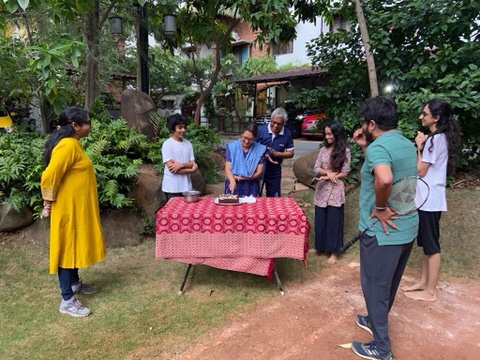
As in the photo above, even while we cut a cake to celebrate a birthday, this neighbour skipped the cake to feel the hunger since it was a Thursday.

A simple off the cuff remark when someone said you need “to feel the hunger” made me think how much I still need to learn on this front. Learning is a life long journey and we possibly learn more as we listen more.

Let our learning blossom forever.

S Ramesh Shankar

16th August 2020