Feel the hunger…

The other day I was playing badminton with a neighbour and he said he was a bit tired and wanted to stop after two games. I wondered what had happened to him as he normally had a good stamina. On inquiry, he informed that he had fasted the previous evening and hence was tired.

He further clarified that he was not fasting for any religious reasons. When further asked for the reasons, he hesitatingly said that he was periodically feeding children in an ashram and hence was fasting on that day. What really struck me is the reason for his fasting. He said he started fasting on every Thursday when the Ashram owner told him that it was not enough to feed the kids but may be good “To feel the hunger” by fasting once a week.

“Feeling the hunger” was a powerful statement and it got stuck in my mind. “Empathy” is not only a word in english but an experiential learning for everyone. Like they say, you need to put yourself in someone else’s shoes to experience what they feel in any situation.

At every stage of our life, we find people sympathising with us but rarely you come across people who empathise with you. The difference between sympathy and empathy is the phenomenon of “feeling the hunger”

As a child when you miss out a rank in the class by a few marks or lose a match for the school there will be many who sympathise with you but rarely some who can empathise. The ability to silently put yourself in the other person’s position is easier said than done.

As you grow into an adolescence and want to rebel at everything in life, everyone around you is critical as they tend to look at it only as a deviant behaviour. However, if one can experience what an adolescent goes through the story would be different. You may lend a listening ear or comfort the person that it is natural to rebel.

Then even as adults you find it irritating when someone gives you advise which they don’t follow. It may be easier to advice others than to lead by example. Leaders in organisations are not respected because they lack empathy.

Today’s generation is not looking for sympathy at all. They are touched by an empathetic leader. In times of crisis nobody looks for advice from the ivory tower. People expect leaders to be on the ground, smell the earth and work along.

Leadership is all about “ feeling the hunger”. It is all about empathy. We need to evolve our ability to put ourselves in other person’s position and experience life as they do. Once we are able to do that, our approach to life and living would be different.

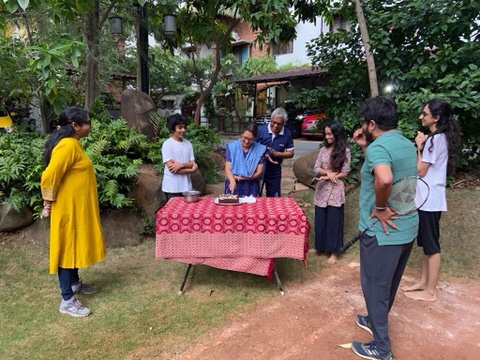
As in the photo above, even while we cut a cake to celebrate a birthday, this neighbour skipped the cake to feel the hunger since it was a Thursday.

A simple off the cuff remark when someone said you need “to feel the hunger” made me think how much I still need to learn on this front. Learning is a life long journey and we possibly learn more as we listen more.

Let our learning blossom forever.

S Ramesh Shankar

16th August 2020

Are all relationships commercial?

In my experience, relationships are the bedrock of life. We can get anything done or not done in life because of a good relationship or the lack of one as the case may be. This is true in our personal lives and work lives. If there is one quality which each one of us have to develop right through our life is “How to be build life long relationships ?”.

Some people differentiate between personal relationships and work relationships. However, in my book all relationships are sacrosanct and are no different. Relationships are based on trust and mutual respect. They are developed through our efforts, actions and personal credibility. They need to be nurtured to become strong and sustainable ones.

One question which may lurk in our minds as to why we need relationships if we are capable of handling our own affairs. We need relationships because we are living in a inter dependant world. No country however mighty it may be can think of surviving and sustaining by themselves. We all depend on each other to succeed. This is equally true in our lives. None of us however brilliant or capable we are can achieve everything in life all alone. We need to depend and collaborate with others to succeed in life.

After spending many years in the corporate world, I can vouch for the value of relationships in every sphere of life. I have seen many brilliant employees who are intellectually smart and have great pedigrees to be proud of but fail in their careers primarily because they are not a team player and cannot sustain relationships at the workplace.

This aspect is equally true in our personal lives. If we recall the people we admire in life, we may recollect the names of people whom we enjoy interacting with and learning from. We may not recollect the most intelligent teacher of our lives but the most friendly one. We may remember colleagues who cared for you and not your best performers. Similarly you remember neighbours who were around for you whether you needed them or not and not others.

Today we find a deterioration in relationships. In my view, this is primarily because we have tended to use people and love things. While being materialistic per se may not be a bad thing but if we love our things and use people, relationships can never be built. We have started believing that we can buy relationships and have started putting a value to every relationship possibly in monetary terms. In other words , we have started behaving as if all relationships are commercial ? In my book, this can be the last nail in our our coffins.

We need to realise that everything in life is possible only by building, nurturing and sustaining great relationships. If we do not understand this basic theorem of life, we may lose more than we may win. Even the victories may not be sustainable in the long run. The day we realise that relationships can make or break our lives, we may have turned the corner.

As in the photo above, all relationships are not commercial and the earlier we realise the better for us to enjoy life to the full.

Lets learn to build sustainable relationships from today.

S Ramesh Shankar

23rd July 2020

Listening to the unsaid …

We are living in a world where nobody has time for anybody. We live, eat and sleep as if we have to catch a train or flight all the time. We behave almost as if we are about to miss our train or flight and hence do not have time for anyone around us.

I remember my childhood days when all of us in the family waited for each other to have dinner together and then listening to the evening news together on radio. Nowadays every member of the family is busy onto to themselves and do not even have the time to talk to each other. In many cases spouses are not even staying in the same home in the same city. Children also are studying in boarding schools far away from their homes and hence family get togethers every day is a rarity.

Let us look at neighbourhood and friends. Having lived in large metropolises like Delhi, Mumbai, Chennai and Bangalore, I can say confidently that most of us do not even know our immediate neighbours. We are so busy with our own career and lives that we do not have time for anyone else in our lives leave alone our neighbours. This makes our homes as houses with just a shelter to spend the night for most of us.

Over and above all this, the workplace is increasingly becoming virtual. Relationships in social media are virtual and there is no emotion attached to it. This makes the world a lonely place to live in. Children do not know whom to share their concerns with. Apart from busy parents, even neighbourhood aunts and uncles are not around to listen to them. At the workplace, the competitive world has made us more self centred and we care more for ourselves than others.

Under these circumstances where does the child go ? How can children express their anguish and to whom ? Even adolescents and young adults find it difficult to express themselves. Friends in social media are measured by the likes they post on them rather than their genuine love and concern for you. The best test is when you are not well – physically or mentally – how many of your friends show concern and lend a listening ear.

It is here I would say that it is increasingly important to listen to what is being said and more to what is NOT. We generally are not sensitive to children, adolescents or adults expressing their feelings to anyone. Anyone who shares their emotions are laughed at. This makes them introverts and they say more in actions and deeds than words.

Like an artist may express emotions through their art or a singer through his music. A writer may express through their literature. We need to worry about how common men and women can express themselves. We need to learn the art of listening to the unsaid. It may be easy to comprehend what is being said but many a time a lot remains unsaid and this is where we miss their emotions.

I remember parents asking why you are sad today. Or a friend sitting along with you in silence to comfort you. A teacher enquiring about a child from their expressed emotions rather than words. A neighbour visiting you for no reasons but just to make a statement that they are around for you all the time.

As in the photo above, we need to sense what is being expressed through her expression even if she does not say anything. In these days of the pandemic and the consequent lockdown, people are feeling more lonely than ever before. A listening ear will be of great support.

We need to rekindle our conscience. We need to learn to laugh and cry. We need to listen to what is not being said in words but expressed otherwise.

Let us learn to talk less and listen more.

S Ramesh Shankar

16th June 2020