
Class is classic 

Class means different things to different people. As a student of sociology, class refers to the social status in society. It is referred to as social class. It is like the caste system, which creates a hierarchy in society. Class could be based on income, caste, profession etc. An act of high quality is also referred to as class. For eg, in the cricket world, we normally refer to batsmen who are outstanding as class. An oft quoted saying is ” Form is temporary but Class is permanent.”

So, let us understand why form is temporary but class is permanent. It is believed the best in class player in any form of sports is classic although she or he may not be in form on a particular day. We can think of the best soccer players going goalless in a match. The best batsmen getting out for a duck and so on. However, their consistency and quality of the game is unimaginable. Hence, we could easily state that “Class is classic”.

If we move to the social class, there is an interesting theory in sociology called “Sanskritization”. This means people who are in the lower caste do everything in their domain to move to the higher caste hierarchy. This is simple aspiration in life. Who on earth would not like to grow ? However sociologists have studied this phenomenon and called it “Sanskritization”. Today it may look obvious that every one of us aspires to learn and grow in every aspect of life.

Another interesting determinant of class is forwardness or backwardness of a community. This is determined by developmental indicators, educational levels, per capita income and so on. So, when communities are behind their contemporaries in the same society due to clear developmental factors, they are referred to as backward communities. On the other hand, when communities move forward in the same factors they are called forward class.

Another interesting classification of society in the past has also been done based on the professional vocation of a group. This segregation then refers to a community as potters , agriculturists and so on. The profession adopted by the majority of a village or a community gives credence to the name of that community or village as a potters village and so on.

Whatever be the definition of class, I would state that “Class is classic”. In order to attain class in anything we do, we have to be the best in class. This means that in a group of artisans if we are the best, we are referred to as class. This has an important meaning for us in life. If we are the best in whatever we do in life, we will be a class apart and nobody can ignore us. On the contrary, class is respected always.

If I link it to the organisational context, most of us waste our time and efforts by comparing ourselves with our colleagues at work in terms of our performance. It would be wiser to compare oneself to self and be the best in class. If we are the best in whatever we do in the organization, nobody can afford to ignore us, least of all our manager. Hence, it is critical to remember that the best in class will always beat their own standards and records and not bother about others.

Why should we waste our time by comparing ourselves with others if we can be the best ? Our competitors should waste their time comparing themselves with us rather than the other way around. Let us excel in whatever work we do and be always better than the best. The best is class and may not be easy to replicate. We have to outshine everyone around us by our class and not by caste or position or power.

As in the photo above, Taj Mahal is class and hence no new architecture of the world has been able to beat its beauty.

Let us learn to outshine ourselves every day.

S Ramesh Shankar
People – the competitive advantage for an organisation

Every company in the world tries to identify what is its competitive advantage ? They look at what markets they operate in ? Who are their competitors ? What are their sources of competitive advantage ? This leads to factors like Cost, Quality, Reliability , Service, Innovation, Products etc. But, I do not subscribe to this theory of management. In my view, all competitors ultimately catch up to your sources of competitive advantage today or tomorrow. Hence, it is only “People” working with you, who are your only source of competitive advantage, which is not replicable.

Hence, if we believe that we have to make our organisation a great place to work – we have to realize that “Managing People” is not nice to have but must have factor for organisational success. If we take the simple example of the auto industry, we will get our answers. Today, the cars produced by different companies in the same segment is not very much differentiated. They have the similar technology, features, price etc. What really differentiates them is the service, which that company provides you before or after the sale of the car. Service is delivered by people and people are the key differentiator.

We have evolved the concept of “Ownership culture” in our organisation. What does this mean – this means that every manager owns her or his people in every possible way. A manager is the friend, guide and philosopher for his team. We need to build the people management skills in every manager so that they take care of their team members.

We launched the “People Matter” programme and the manager fitness certificate to support this philosophy in Siemens. This would help us strengthen the ownership culture by creating highly motivated teams. This would in turn enhance our customer experience. Like they say, if you take care of your employees, they will take care of your customers.

In this intervention, we partnered with Great Place to Work(GPTW). The reason why we selected GPTW is because we wanted a partner, who understand India and also helps us understand the best people practises in the world. They have helped us customise the programme to suit our context. They have benchmarked us with the best in the world and are supporting us to become the best.

This has been an exciting journey for me personally. I travel across the company and have visited almost all locations of Siemens. Everywhere I have been since the launch of the People Matter programme, employees have told me that they see the significant change in the behaviour of their managers. This is very heart warming. They tell me that their managers listen more and spend more time with them for their own development.

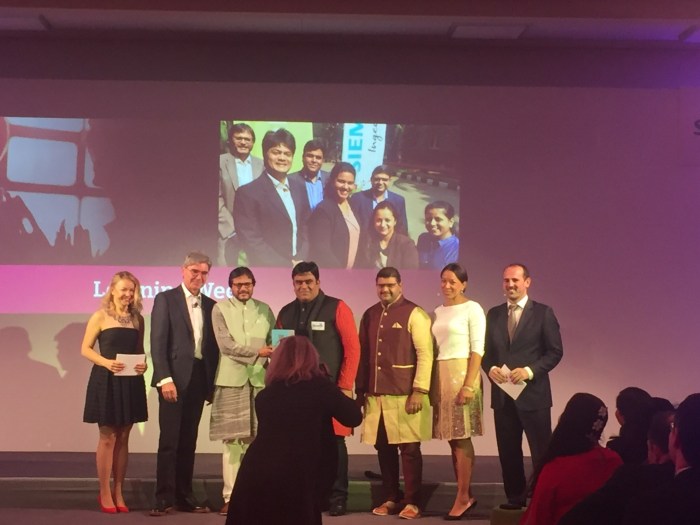
It is the people in the organization, who make a difference as illustrated in the photo above.

We would like to make this a way of life in Siemens. This is not a one of flavour of the season. We want every people manager to be the face of the employee in Siemens. We will empower them to take people decisions for all their team members. We will incorporate this in some way towards the “How” assessment in the PMP process. We will reward and recognise the best people managers periodically across the company.

We believe that it is “Customer first” but “Employee always” in Siemens.
 
S Ramesh Shankar
 

Campus to Corporate…

All of us look forward to our first job in our life. We eagerly await the completion of our formal education in school/college to enter the corporate life. We want to stand on our own feet and live out our dreams in life.

While this journey is indeed exciting, we have to prepare ourselves to be successful in this phase of our life. What are the changes which one has to encounter when you leave the college premises and enter the corporate world?

A. Forget your pedigree at the compound wall of the corporate : While your pedigree may help you enter the corporate world, it will not make any impact after you are in there. What makes a difference is your performance and the value you bring to the table.

B. Unlearn, learn and re-learn : Unlike the academic world, the corporate sphere changes very fast. We need to learn to unlearn, learn and re-learn at a hectic pace not only to survive but to thrive in the corporate world.

C. Excel : Excellence is a journey and it is never ending in a corporate world. You have to be the best in whatever you do and then nobody can ignore you. Kindly remember that this world is much more competitive than the academic world and you may not always get a second chance.

D. Ambition : Dream big and you will be able to realize your dreams some day. It may not happen in the time frame you have set for yourself but if you do not give up, it will definitely materialise.

E. Morals : It is always a dilemma in your mind if ethics have any value in corporate life. You may have seen millionaires making money the wrong way. You may be tempted to take short cuts and realize your dreams. Just remember to listen to your conscience every single time and you will do no wrong. It is better to be happy and hold your head high rather than be rich and evade the taxman or the police all the time.

F. Stand alone : It is natural for you to compare your self with others working with you. You may wonder why you get paid less as compared to someone else working with you. You may think the other person is less qualified or has irrelevant experience. It is not worth comparing yourself with others and feeling bad about it. You need to learn to be like the pole star comparing yourself with yourself and shining so brightly that nobody on earth can ever miss your sight.

G. Commitment : One may get away by submitting your assignment late in college once in a while. However, in the organisational context, living up to your commitments is the key to success. Your relative value is always determined by your personal credibility.

H. Punctuality : Self discipline is expected in corporate life. Nobody will remind you to be on time. You set your standards by being on time all the time. Your reputation is determined by your punctuality. It is good to remember that your discipline is displayed when nobody watches you.

I. Mobility: In today’s globalised business environment, one need’s to be truly globally mobile to be successful. We should be willing to pack up our bags and go anywhere in the world to launch a global career in any organisation.

J. Team work : Unlike the college daya, where one could get away with individual excellence, team work is the key to success in organizations. One needs to learn to work in team and collaborate and cooperate to leverage on the strengths of each team member.

Now, let us look at the emotions and feelings we may experience as we enter the corporate world and how do we deal with them :

I. Happy and excited : The enthusiasm and joy has to be sustained and persevered. We may not always get what we want but by sheer hard work and determination we can lay our own career path in the organisation.

II. Fear : The lurking fear of not being good enough will confront us. Our ability to be humble, grounded and willingness to unlearn, learn and re learn will help us get over fear.

III. Unhappiness : Not getting the location of your choice may make you unhappy. But our ability to adapt and make the best use of every opportunity will help us excel.

IV. Anxiety : Everything appears new and unknown. How to ask and whom to ask is a constant question in our mind. Simply asking and being innocent will help you always find your way.

V. Intimidating : The induction programme may be intimidating and you may find your self lost in a big organisation. Kindly remember all of us joined some day and today it is your turn. There is nothing to worry as you will come to know of everything as days pass by.

VI. Nervousness: The fear of the unknown and the realisation that time will run out fast may make you restless. As long you realize that learning is a life long journey, please remember that everyone in the organisation will be keen to help you.

VII. Curiosity : You are not sure when to speak and when to listen. You are curious when to ask questions and whom to ask. There is no right or wrong answers. As long as you are authentic, you need not worry about anything or anybody in the organisation.

Some things to look forward to :

A. First salary : The thrill of getting your first salary in life is unbelievable

B. Own office desk: When you reach office on the first day and get your own desk to sit, it is a matter of pride.

C. Corporate credit card: On getting your corporate credit card, you feel as if you have arrived in life.

D. Colleagues / friends – It feels nice to have new friends and colleagues at work and learn from them

E. Visiting card : Your first visiting card gives you respect and credibility

F. Independence : As we stand on our own feet, we become self reliant

All in all, moving from campus to corporate is like transitioning from bachelorhood to married life. Unlike your spouse in married life, you will have colleagues in the organisation. It is our ability to adapt and learn from them, which will make us successful.

The nervousness of the student transitioning into the corporate world can be seen in the photo above.

Wish you all the best.

S Ramesh Shankar