Intent versus Action

I was wondering what I need to reflect on for the new year. I was reminded of the famous saying that read – ” A slip between the cup and the lip”. In life, many a time, there is slip between what we intend and what are are actions portray.

Today we are in a state of flux. We are at the threshold of massive change. India is poised at the right inflection point and we have a lot to gain if we act fast and in the right direction. If sometimes our actions misfire, we need to reflect on our intent and change course so that we can move in the right direction always.

We need to reflect on this point as a country, as a state, as a community and more importantly as an individual. Many a time in life our intent may be noble but our actions may not be in sync with our intent. It is never too late to reflect on it and change course if our actions do not lead us to our goal.

It is as simple as driving a high end car on a freeway. You may be enjoying the drive and may be at good speed but if you realise that you have taken the wrong freeway, it may not lead you to your destination. So, in life, if we need to change course to realise our goals we should and not get stuck on anything we have zealously pursued.

Let me start as an individual. Most of us are adept at making new year resolutions. We aim at the moon and make sky high commitments to ourselves. However, we realise that most of our resolutions die even before the ink dries up on the paper on which we had written them. It may be a good idea to reflect and take one small thing at a time. For eg. this year, we could resolve that we will appreciate one person around us every day. This may bridge the gap between intent and action as it is simple and it will give us immense joy in doing it every day. Life is a journey and there would be commas and full stops midway. This does not mean the end of the road. It only means we need to start all over again.

As a community, we have a rich heritage and we need to learn from our culture. We have to live and let live. We need to be more tolerant and inclusive in our intent and actions. Today we see violence all over and this is not what our culture taught us. We always were proud of the quote – “Vasudeva Kutumbakam”- the world is one family. As individuals we have to realise our duties before we try to exercise our rights.

As a country, we need to focus on our basics. We still have a long way to go to ensure food, clothing and shelter for all. Our focus has to be on these fundamentals. The government has to collaborate with the public and all political parties to deliver this. Let us ensure that every individual has her or his basic human needs fulfilled. Today we are 129th on the Human development index in the world. We should be among the top ten in the next decade.

Political parties need to learn to work together to achieve this goal. We have attained a lot of milestones since independence. If all parties come together, there is nothing we cannot achieve as a nation. Sometimes, we may make mistakes and it is fine to accept and move on. Our actions should always lead us to our goal. If they don’t, we need to have the humility to accept the same and change tracks and move on.

We cannot afford to move backwards as a nation. No political party has a right to damage public property as a mark of protest. Violence has no place in a civilised society. If we have to protest against anything, let us do it in a legitimate way. Let us learn to debate without offending anyone or hurting someone’s feelings.

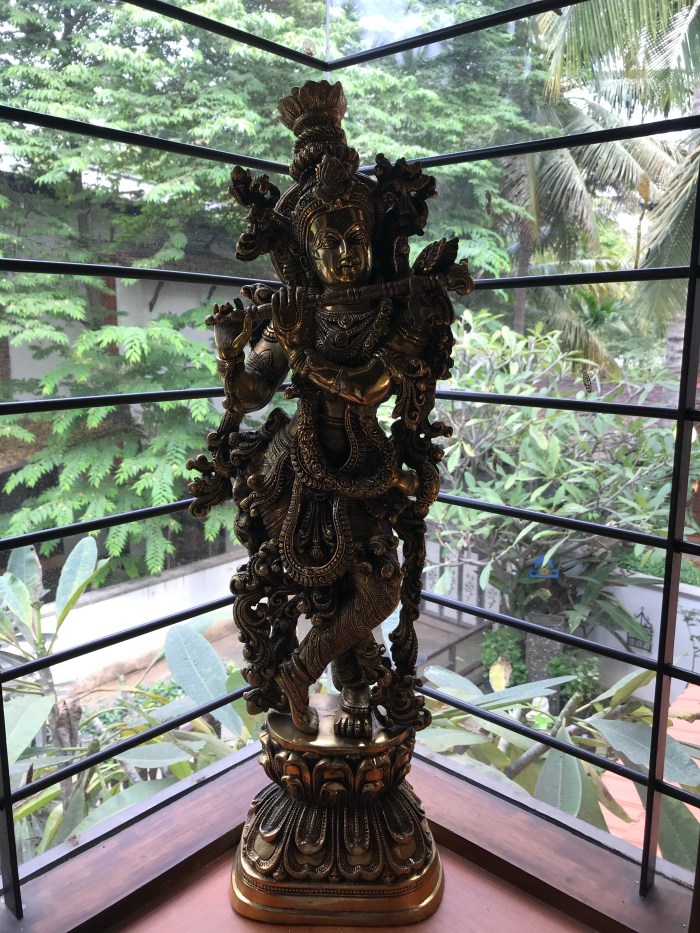
May be time to learn from Lord Krishna, the eternal coach as in the picture above.

People in governance have the responsibility to lead the nation. They need to take others along in this journey. People in the opposition have to realise their responsibilities too. Who governs today may be in opposition tomorrow and this cycle will always go on in a democracy. Let us lead this country to be amongst the most developed and the happiest in the world by learning to work together as individuals, communities and as a polity.

Proud to be an Indian now and always. Wish you and your near and dear ones the best of everything in the new year. I would urge you to resolve to appreciate one human being around you every day in the new year.

S Ramesh Shankar

31st December 2019.

Spaces

IMG_1649Each of us love our private space. At times, we like to be left alone. Nobody can define what is the right space we need at any time in our life. There are times in our lives, where we feel comfortable surrounded by friends or relatives. There are other times, when we want to be left all alone. Each of us define our space based on time and our personal needs. There is no right or wrong answer to define the space we need.

The interesting aspect of space is that sometimes we want people around us and at other times we do not want. This is true for individuals, communities, societies and nations. Every individual enjoys her or his personal space. Although, we cannot draw a circle and define our space, we tend to evolve it based on needs and moods. It could change with time, space and stage of our life and it is fine to be that way.

It is important to realise that while we enjoy our space, we need to respect the space of others too. We get irritated if someone intrudes into our space but are less concerned when we do the same. This is the lesson to learn in life. The territory of others is as valuable to them as it is to us. We realise the value of it only when our space is infringed by others. It may be useful to respect others’ s spaces without being reminded of the same.

Interestingly, this phenomenon is equally applicable across nations too. In a global conference, social scientists can interpret relationship between states by the distance they keep between them. It is important to realise that every sovereign country likes to protect its space. No country likes its space to be intruded by others. We can note that even in international boundaries, there is always a neutral zone between states. This is also to ensure that no country intrudes into the territory of others even by mistake.

Another dimension could be the space we occupy even in our offices. If we try to trespass into the space of our colleagues at work it is not appreciated. On the other hand, if we keep a distance from other team members they feel ignored . We need to strike the right balance between proximity and intrusion. The line is very thin and we may learn by experience. Different people and different organisations may view this differently.

Even in our neighbourhood, it is delicate balance to maintain the right distance. If we get too close to our neighbours, they may consider it as an intrusion. On the other hand, if we keep a safe distance, they may interpret it as aloofness on our part. What is the right distance to maintain is again not defined by laws of physics or sociology. It is learnt by experience and is also situational. In a crisis situation, neighbours would appreciate closeness and proximity. On the other hand, on some other occassion, they will prefer to be left alone.

Interestingly the concept of spaces could be experienced even within the family. What is right distance you need to maintain with your elders or with your children is difficult to define. If your ignore your parents, they will feel neglected. On the other hand, if you your start advising them every day on everything, they may feel suffocated. The same may be true for your children. When should you get close to them and when you should leave them alone to learn from their own deeds is a matter of judgement.

As in this photo, the distance between friends was not planned but happened as we sat across a table in a marriage reception. We all liked it and the conversations were cordial and friendly. I am not sure if this was caused by the space between us or in spite of the space. It may be just incidental and may not have any basis at all. Hence, it is not worth spending your life thinking and planning about spaces. But, it may be a good idea to learn from our mistakes.

Lets keep the right distance.

S Ramesh Shankar

Change is good

Change is the only constant in today’s world. The most interesting aspect is the rate of change. Earlier, we would be happy to anticipate a change once in a few years. This became months, days and now life changes almost every minute. One of the reasons could be technological breakthroughs in society. I remember in the eighties we would get an update of the world news on television only once a week. Today, we are updated every minute through news apps.

Organisations and individuals are constantly dealing with change every day. Let us first examine it from an organisation perspective. Every organisation is confronted with change at every stage of its evolution. If it is a startup, dealing with change is the foundation of its existence. After an organisation matures and becomes stable, change in the environment helps the organisation to shake itself out of slumber and learn and grow.

The story of change is no different for us as individuals. In the earlier years, we had the luxury of following age old practises without being challenged. Today the rate of change of the environment is faster than we can believe. It changes very rapidly and impacts us in multiple ways. Our success lies in anticipating the change, accepting it as our current reality and learning to adapt to the change to our best ability.

Our society is also dealing with change in every way. Nations, communities and societies are experiencing unprecedented change. The boundaries of nations get blurred with economic unions cutting across countries like the European Union. This makes change inevitable. Both suppliers and customers benefits from such changes. It also impacts regulations and taxes across countries.

The biggest challenge of change is our ability to accept it and adapt to it. If we resist change, then we get overwhelmed. I remember the first days of the computer and the email. Senior managers were wary of this change and felt powerless without their secretaries sorting out snail mails for them. They even resisted the use of computers for word processing and database management. Today the computer is gradually getting replaced by the mobile phone. Our office resides in the mobile phone and every activity can be done on it if we are willing to learn to do it.

I am aware of grand parents attending computer classes to learn to send emails and chat on video platforms with their grand children who live across the ocean in different continents. Age, sex, religion or nation will not matter to adapt to change. It is our mindset to unlearn, learn and relearn. It is important to remember that change is the only constant in an ever changing world around us.

The earlier we are able to anticipate this change and adapt to it, the more successful and happy we would be in life. Most of us spend time in denial. We then try to postpone an issue claiming that a particular change is not for me. It is this attitude we need to change. The moment we realise it, we become a winner. We are able to lead the change and reap the benefits from it much better than others.

Playing football in the pouring rain made me realise that change is good. If I could play in pouring rains, I could do better during normal weather.

It is important to realise that change does not wait for us. It encircles us and moves on. If we do not learn to change, we may get changed forcibly and that experience may not be good. It is better to master change then be engulfed by change. This is true as individuals, communities, societies, organisations or even nations. As someone nicely said, ” The future has a habit of suddenly and dramatically becoming the present.” If we learn to foresee this future, we lead the change.

Lets change today.

S Ramesh Shankar