Everyone has an expiry date

Today I read in the morning newspapers that a senior bureaucrat in the government is retiring at the end of this month and neither is keen on an extension nor an alternate role in government. I salute this bureaucrat. All of us have to realise that we have an expiry date. Unless we give way, we cannot give opportunities for others to excel and prosper in all fields.

I have seen this phenomenon quite prevalent in corporates. The senior managers starting from the CEO think that they are indispensable and never want to let go. We all have to realise that there is a pre determined expiry date for all of us. It is like a medicine when manufactured has a pre printed expiry date. Life is no different.

When we are born on earth, God has already decided our date of death. Similarly when a food item is produced the expiry date is printed on the packaging itself. We need to realise that in our careers too this is applicable. We all have to come and go. We may be excellent in whatever we do but we need to give way at the right time for the next generation to take over.

This is equally true in sports. We find many senior sportspersons reluctant to hang their boots even when their talent is fading. They want to live in the past glory and do not give space for the younger talent to prosper. It is better to realise that we need to give way when people ask – ” Why now ? ” rather than “Why not now ?’.

Even in the family, we need to realise when our role expires and we need to give way to the next generation. We should not hang on to power as if nobody else can do better than us. We may be surprised that the next generation may do better than us. They are smarter, more energetic and may work differently.

This is equally true in our political system. Our political leaders never want to retire. I recently read about a veteran politician changing political affiliation just to get a parliamentary seat. It is true that our political system does not specify an age of retirement. However, all political parties should decide that everyone should retire and give way to others at a particular age.

It is more about our inability to accept the reality of age and cling on to our positions and roles. We have seen this in organisations, sports and politics that the gen next always surprises us positively.

All of us have a responsibility of giving way and letting go. We need to realise that everyone has a start date and an end date. While we can continue to excel in whatever we are doing, we need to give way when the time comes to retire. We should not find ways and means to delay this decision. This will harm the organisation more than we can imagine.

I have always believed that when working in an organisation I was aware the day I joined as to when I need to hang my boots and enjoy life as in the photo above.

Life is fair to everyone. We all need to realise that there is a beginning and end to everything in life. We can do everything to begin well, work hard and excel in whatever we do. But the day when we feel we have reached our peak, we should learn to give way.

Let us learn to give way always.

S Ramesh Shankar

18th November 2018
The generational transition

All of us grow up hoping to study well, settle down and fulfil our life goals. Then we want to get married, have kids and be happy in life. This a natural human phenomenon. The relationship between parents and children is special. It is fun to spend time with your kids and play with them and see them grow up.

The real test for us as parents are when they grow up as adolescents. They turn rebellious and challenge us in our role as parents. We feel threatened because they question our role and even the support we provide them as parents. The feeling is like someone removing the umbrella from your head during a heavy downpour. We find it difficult to cope with this transition and try to manage the situation to the best of our abilities.

Some of us tend to look back at our own lives and recalling our teen age behaviourand accept this as the cycle of life. We believe that we did the same with our parents and now it is our turn. Others find it difficult, when challenged by their own children. Our values are threatened and questioned. Their habits, behaviour and social company becomes almost unacceptable to us. Our teenage children believe we are living in the past and are not willing to accept the present.

If you talk to psychologists or counsellors, they guide you to be friends with your kids. This is easier said than done. It is like a fire fighting drill. As long as it is a drill, all of us enjoy it and have fun. But, if a fire really breaks into our homes, we may not find it easy to handle. We feel as if the counsellors and psychologists are making us believe that dealing with adolescent or young adults at home as kids is like a fire fighting mock drill. Fun as a drill but difficult to practise in reality.

Life is different. The realities of this transition in your child’s behaviour is to be experienced to be believed. It is almost like a consultant giving advice on how to deal with a crisis in a class room. When the real crisis hits us neither the consultant is around nor we remember the strategy he taught us in the class. It is like all organisations have crisis management manuals prepared and certified by quality auditors. But when the real crisis hits us, neither the manual is readily available nor do we have the time to read and act as prescribed.

Then how do we prepare for this crucial stage of our life. Some of the tricks, which we have tried and tested are as follows. As parents, one of us can get closer to the child, evolving as a friend over a period of time. It may or may not work but it is worth a try. It is also useful to find out who in the inner circle of relatives and family friends is closest to our kids. We need to find the person whom the child trusts blindly and will be willing to confide in. This may help us enable the kid to share their concerns openly with them and thus minimise tension and perceived misbehaviour at home.

This phase of life teaches you that there is a generational shift. You suddenly realise that you have grown up and have children, who are from a different generation. It may also be useful to be in touch with the realities of today. The needs, wants, behaviours and motivation drivers for our kids is different today. We may or may not appreciate them but we need to accept them as our current reality.

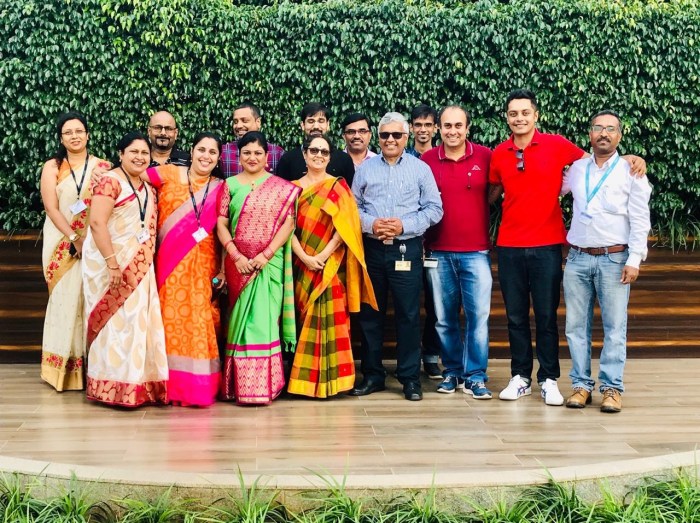
As in the photo above, the generational shift is visible even in the organisational setting.

The earlier we face this reality, the faster we are likely to adapt and change. If we live in the past, the future may hit us harder. The future will become the present sooner than we realise. So, it is better to co create the future along with our kids by adapting to this changed phase of life rather than be a victim of the change.

Together , let us create the future.

S Ramesh Shankar

12th September 2018

Talent, aspirations & opportunities

Today there seems to be a mismatch between the talent in the market, their aspirations and the opportunities. The millennials of today are not keen on a 9 to 5 job. They want to pursue their passion cutting across organisational boundaries. While organisations may offer routine jobs, their aspirations may never be met.

What do we do in such a divergent environment ? While opportunities in the environment may change as per demands of the industry and the market, the aspirations of the next generation needs to be understood to be met.

Permanent employees may be a thing of the past in industry. We are moving towards a gig economy. This means jobs may be split and people may be available part time to share their knowledge and skills on a contractual basis. There will be neither permanent jobs nor permanent people in organisations.

Everything will be in a state of flux and change. While jobs will appear and disappear at frequent intervals, people may also keep changing their jobs and organisations as per their current aspirational needs. Thus aspirations will also keep changing with time. Nobody is going to stick to a particular organisation or profession for life.

A friend of mine was sharing with me that post his retirement after a long and illustrious career he was pursuing painting as his hobby. A few months later he informed me that painting was passé and now he was writing a novel. The aspirations of the millennials of tomorrow will be somewhat similar. It may change many times a year rather than even once in a few years.

Organisations have to redefine jobs to match these transcending aspirations. There has to be a market place for opportunities and aspirations to match. The cycle time for change will be frequent. This has to be managed through automation and artificial intelligence. It looks like there will be nothing permanent in life.

Even the personal lives of the future talent will be different. Family and marriage as institutions may fade away. The boundaries of a nuclear family may give way to living in partnerships as per mutual convenience. Marriage may no longer be a social pre requisite to have children and hence may disappear.

Organisations have to spend a lot of time and money to understand the aspirations of this generation. Sociologists and Anthropologists may play an active role in redefining roles and matching aspirations of the future talent. Thus organisational boundaries may fade away. Talent may work in multiple organisations as per their interests and time availability.

The talents today are like the balloons in the photo above.  Multi varied and with different and needs.  We need to create an environment where every talent blooms.

A new era where there will seem a dynamic relationship between opportunities, aspirations and availability of talent. Organisations which are flexible enough to match these changing trends will be successful in the market place. Organisations which continue with rigid job definitions may fade sooner than realise.

Flexibility may be the key to success.

S Ramesh Shankar

9th September 2018