I became an HR professional by choice and not by chance. Now, if I look back at my career it has been a mix of ecstasy and agony at different periods of time. Both the organization and the environment contributes to it. But, I suppose it has been up to me to convert every agony into an ecstasy by creating opportunities for myself.
Let me reflect on some events of both agony and ecstasy to make my point. The first instance was more than three and a half decades back. I was posted to an iron ore mine more than 100 km away from a steel plant in central India. The joy of being selected into a public sector steel giant vanished after my training was over and I was posted to the mines. Within the first 48 hours I was gheraoed by the unions for more than 24 hours. It was agony at its worst, to say the least. However supporting managers and a great team helped me to convert this agony into a valuable learning experience. Even today, I am able to work collaboratively with unions and win their trust based on this experience.
The next big experience was in an automobile company more than two decades back. We had a big dream to evolve a vision and involve all employees in the change process. This was one of my best learning experiences of managing change and successfully implementing it. We introduced the “large scale interactive process, wherein we involved all the 1000 employees working for that business to evolve a common vision, understand where we were, where we wanted to go in 5 years and how do we get there by implementing the action steps. It was one of my most ecstatic moments as an HR professional. I have been practicing this learning even today to involve a large group of employees and implement real time strategic change efforts successfully.
About a decade and half back at an FMCG company I learnt the art of building trust. We had lost the trust of our employees and management lacked personal credibility. Again, although it was a crisis like situation, the support of a new enlightened management team helped us to re build that trust and gain employees’ confidence back over three years. Yet another situation of anxiety converted into an opportunity.
Today I work for a MNC. As a HR professional, I have learnt that we can convert an organizational crisis into an opportunity. Our customers were unhappy with the company. We worked with the management team and launched a “Customer first” intervention and trained more than 8000 employees to win customer confidence back. In this process, we not only earned customer loyalty but trebled our customer engagement scores. This has been one of my most gratifying experiences in HR to make a direct positive impact on our end customers.
Another learning experience in my current organization has been transforming our relationship with our unions. Although, we have internal unions, we had a evolved a love hate relationship resulting in at least one labour case filed by our union every month against us. We worked on this issue in a very systematic manner through establishing communication channels, reviewing all pending disputes in a fair manner and mutually withdrawing court cases and settling them through bilateral discussions. This has resulted in zero court cases filed in the last three years. This has been possible only due to objective support of both the union and management representatives.
All the above experiential learnings have taught me one lesson. Every crisis is an opportunity. As an HR professional, we cannot expect that our career journey will be filled with roses. It is always thorns and roses. It is up to us to convert every thorn into a rose by working on it.
One thing is true in today’s organization for all of us. What I learnt yesterday may be useful today. but may not make me a winner tomorrow in the market place. The rapid transformation of technologies and its impact on people, processes and organizations will have a huge impact on the role of HR.
One major impact I can foresee today is that although technology has provided multiple channels to efficiently communicate with people around the world in seconds, it has not enabled the effectiveness in the human connectedness. We may have a landline, two mobile phones, a tablet, video conferencing and IP calling facilities today but we do not talk to each other and understand each other as human beings. While I am a big fan of technology, I am equally concerned about the human alienation and loneliness within families, organizations and societies. This is a a big challenge for the HR professional to address since it will have impact on relationships within and outside the organization.
The generational shift will have its own consequences. Our ability to manage and balance multiple generations will be a strategic advantage for organization if HR is able to plan optimal interventions. Further, the VUCA world will challenge business models and impact the future of work. In my assessment, this will get impacted in five distinct spheres – work, skills, space, technology and life. All this will mean leaders have to adapt their styles to manage these radical shifts in organizational mindset of employees. HR has to partner employee and co create the future together with them and their manager in a digitized world of the future.
Diversity & inclusion will be an added dimension as a challenge to the HR function. It will be expected that the HR function facilitates diversity and inclusion as a culture in the organization of tomorrow as it is no longer a fad but a strategic advantage for better business outcomes.
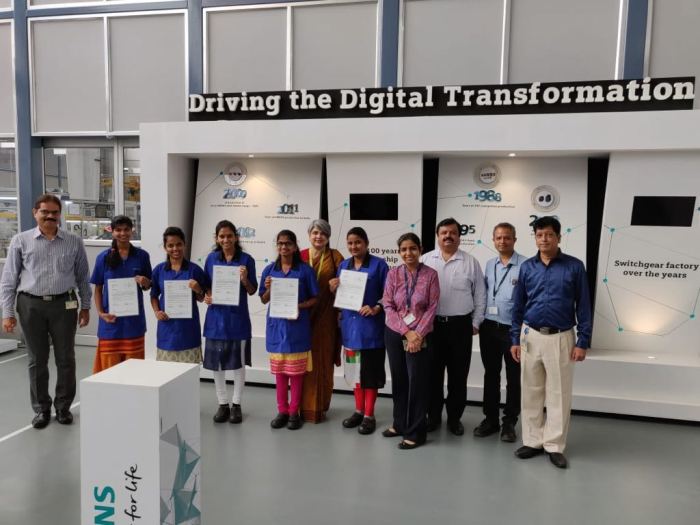
As in the photo above, when five girls join the shop floor of your digital factory, you feel diversity is in action and not a slogan anymore.
One vital question for the HR professional today could be the survival of the function itself? Some thought leaders are questioning the need and survival of the HR function in the future world. I would think that as long as human beings exist, HR function will exist. However, tomorrow if an organization is going to be run by robots and AI then HR function may not exist. Having said that, it is important that HR function continually adds value to the business to ensure it is future proof.
Today’s environment is changing even before we realize it. Data analytics may alter business models and decisions. Cloud computing and artificial intelligence may crunch response times. Internet of things and connected devices may radically transform the way we experience life today. But human emotions and empathy will remain. It is up to us to anticipate this change and thrive on the chaos and convert every agony into an ecstasy by empathizing with our employees, suppliers and customers.
Every agony when reversed becomes an ecstasy.
The choice is ours.
S Ramesh Shankar
12th July 2018

 Hrishti - S Ramesh Shankar