Life is more than an individual…

We sometimes fantasise that life is all about ourselves as an individual. This is truly a fantasy. The earlier we realise , the better it may be for our lives. Let us start from our personal lives including our family, friends and society.

Imagine how life would be without being part of a family. We may be born alone when we arrive at earth but there can be no life without being a member of a family and a community. It is rightly said that man is a social animal. We cannot imagine leading life all alone. We need siblings and friends all the time to enrich our lives.

This is the reality of life from childhood to senescence. Imagine a child growing up all alone with nobody around to play with. Imagine a youth without friends around her. Can we imagine a senior citizen living all alone at home and staring at the four walls ? Life would not only be boring but may be difficult to live through.

We need support from everyone around us in our family and social circle to grow up and succeed. We need guidance and direction from more experienced people than us. We need recognition and support when we slip along the way. We need someone to lift us up when our morale is at an all time low.

The situation is no different when we are at work. Some employees dream that the organisation exists only because of them. This is again a dream till they realise that they exist, learn and grow only because of the organisation. Organisation again is a social enterprise. It is not the building or the machines, which makes an organisation. It is the people working in them. No individual can succeed without enabling peers at work, a motivating manager and supportive customers and suppliers.

Even the best performing employees realise that they can never be successful without their team. How can one imagine of doing everything alone in life ? It is neither practical nor possible. The earlier we realise this reality in our career, the more successful we are likely to be.

Let us examine a football team. Even the best player in the world cannot score a goal unless he is supported by other forwards in the team. We see this in action. Many outstanding players lose out in the long run because in spite of great talent they fail to realise the value of team work.

Sometimes by looking at the mirror as in the photo above, we tend to believe that that life is all about ourselves till we come out and see the world.

Life is no different. As we have seen whether in the family, work, community or society, our success lies in our ability to grow beyond our individualism. We need to realise this early and learn the art of working in teams. It is the give and take in life, which will make us successful.

We need to realise that no individual is larger than the team she represents. If individuals excel in team work, they may be more successful than others. So, life is all about working in groups and enabling each other to succeed.

Let’s transcend from individual to team thinking today.

S Ramesh Shankar

16th November 2018

Managing performance in the digital age

All of us wonder as to how do we manage performance in a digital age ? We are not sure of our markets, customers, competitors and even types of employees. How do we measure performance in such a fluid state ?

The basics of a good system :

A good performance management system consists of target setting and performance review, assessment of competencies, rewards and recognition and potential assessment. So, why complicate our lives in a digital age. Let us try to keep it simple.

Target setting :

We could evolve a system of target setting for shorter periods of time. It could be quarterly target setting and review. As of today, we may have clarity from one quarter to another. So, let us set simple measurable targets and review them at the end of every quarter. If the targets themselves become redundant within a quarter, let us review the targets itself.

We possibly need to set dynamic targets, which are reviewed periodically during the course of the year like the moving train in the photo above.

Quality of dialogue & feedback :

The crux of a good performance management system in today’s environment is not about the system but the quality of dialogue we have. The millennials are not worried about targets not being set. They are more concerned about the quality of dialogue and feedback so that they can continually learn and grow.

Competencies :

Now, if we move to assessment of competencies – the first step would be to define the set of competencies relevant to the business and the environment it operates. We need to keep this simple too. A focussed approach on defining one or two functional competencies and one or two leadership competencies would be effective. These could be again reviewed every quarter based on the dynamics of the environment

Core values :

The core values of the organisation should be the bedrock of the system. This will not and should not change with time. Many organisations do not spend enough time and effort to define their core values and beliefs. This is critical for success and sustainability of an organisation. While nothing prevents us from a periodic review of these too but core values have to remain core at all times and should stand the test of time.

Rewards & Recognition :

Now if we move to rewards and recognition, the timing is most critical. The generation of today looks for instant gratification like two minute noodles. Our reward and recognition systems should be designed to recognise instantly. The time gap between a critical incident and reward given for it should be minimum. Empowerment of the first line managers is critical for this process and its effectiveness.

Performance vs Potential :

Last but not the least a good performance management system differentiates performance and potential. We should design the system in such a way that performance is assessed and rewarded every quarter whilst potential can be assessed at the end of every year and recognised through exciting projects and assignments.

Success of a good PMS :

The success of a good PMS in today’s era will lie in a fully automated system which is simple, transparent and empowering. The focus should be on the quality of dialogue and feedback between the employee and the manager and not on the robustness of the system.

Role of people managers :

We need to train and certify people manager on a periodic basis to achieve this goal. We need to remember that even in the digital age AI will not be able to express human emotions like the managers can in person. Hence the success of the system will be skills of the managers in dealing with millennials with human touch in an era where human interactions are likely to diminish otherwise.

S Ramesh Shankar

5th March 2019

Transforming engineering education in India


Many of us working in corporates continually complain about the quality of engineering education in India. We state that the students are not industry ready and the syllabus is outdated. The question to ask ourselves is what are we doing about it.

We have some German multinationals leading the way in this space. They have launched scholarship programmes for engineering students across the country. They go to more than 22 states and to the remotest government engineering colleges and select meritorious students from the poorest of families.( annual income less than Rs. 2 lacs per annum). They are selected through a objective technical and psychometric evaluation process.

These students then join the “scholarship programme”. This scholarship covers the cost of their engineering education. They are provided a laptop, mentor from the company and internships every year during their engineering education. Further they are trained on the latest technologies and also on soft skills like communication, presentation skills etc so that they become industry ready from the day they join corporates after their engineering education.

The highlights of the programme is that it is designed based on the reliable German dual education system. This is a holistic development plan with soft skills training, internship in company locations, functional and technical training including certification. This not only ensures industry ready students but also ensures that students are trained and certified in the latest technologies so that they are future proof.

The scholarship programme is different from other similar programmes in that it is much more than a financial assistance programme. It provides the following inputs to the students and enables them to be fit to work from day one of their joining an organisation post their engineering education.

A. Holistic development : The training over the period of 4 years comprises of technical training, functional skills, personality development, soft skills training, communication skills and ably supported by mentoring.

B. Mentoring : Every student is mentored by a senior manager from industry so that they can be moulded in both their functional skills and personality development. They are also inculcated withe values and ethics of business.

C. Technical training : Most industries complain that the engineering education does not train students in the latest technologies and make them industry ready. Our programmes cover the latest technologies and also certifies them in areas like mechatronics so that they are better equipped with practical inputs before they enter industry as engineers.

D. Soft skills training : The biggest challenge engineering students face when they enter industry is on soft skills and business etiquette. This programme ensures that by the time they finish their engineering course, their communications skills are sharpened and they are groomed with business etiquette’s. They can confidently present their views verbally and also through presentations and reports. They are also given inputs on Smart study techniques, effective conversations and time management. They are also made aware of emotional intelligence and self awareness. They are trained for effective participation in group discussions, personal interview

E.Personal vision & career management : They are trained to evolve their personal vision and manage their career so as to reach their life goals. This enables them to evolve as confident and responsible citizens.

F.Interpersonal skills : One of the challenges while entering industry is to work effectively in teams. Hence, they are trained on interpersonal skills, assertiveness and social skills so that they can contribute effectively as team leaders and team members.

G.Cross functional training : They are given inputs in sales and service, manufacturing, quality, supply chain and finance. This ensures that they get multi functional exposure and understand inter dependencies in an organisation.

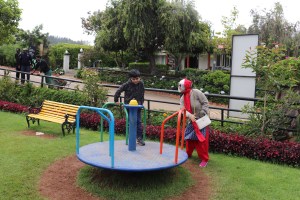
As in the photo above, the child may learn laws of motion in a park better than in a classroom if demonstrated through practical experiments.

This model of training engineering students by these organisations are a practical and sustainable approach to transforming engineering education in India and making them industry ready. It is time other organisations follow this or similar models so that we can contribute to transofrming societies at large. We can bridge the gap between industry and academia and play our role responsibly to make the impact.

S Ramesh Shankar

Founder – “Hrishti”
14th May 2019