
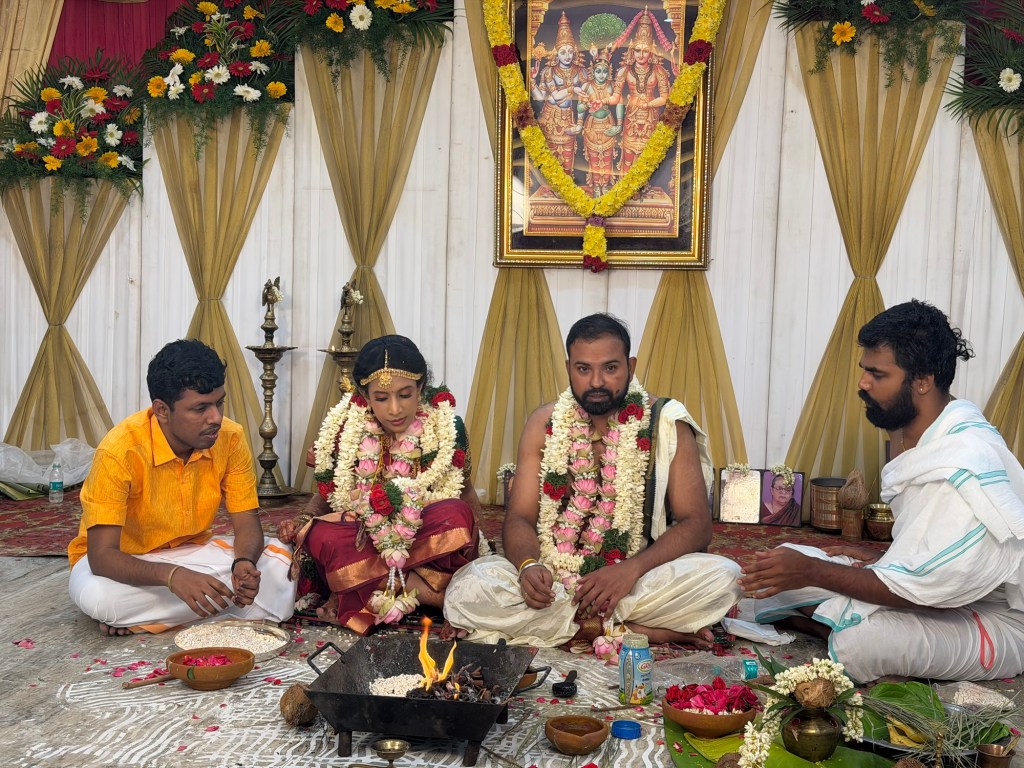
I attended a marriage function of a close relative recently at Chennai. It was after quite some time , that I had the opportunity to sit, enjoy and reflect, on every ritual in the function. This gave me an opportunity ,to observe all the happenings around me ,with curiosity.
The first and foremost thing which struck me was that “marriage” is a social institution, which provides an opportunity for extended families of two sides ,to meet, interact, socialise and build ever -lasting friendships.
We meet our cousins, elders, friends and relatives and recall our enjoyable days spent together during our childhood or while we stayed near each other. We also get an opportunity to meet family and friends of the bride and bridegroom’s and this enables us to evolve , new relationships.
I enjoyed all the rituals of the marriage ,like the fasting ceremony, the engagement ceremony, reception and the marriage solemnising ceremony. Each ritual is performed with a lot of thought and social relevance. For eg, the “Vratham” or fasting ceremony done by the girls parents and the boy’s parents ,is an occasion to fast and pray to the Almighty and all elders ,to ensure that a complex function like a marriage ,happens smoothly ,without any disruptions or misunderstandings. They seek the blessings of the elders ,for the transition from bachelorhood/spinsterhood to married couples.
Then, if I move to the engagement ceremony. It is an opportunity to publicly announce that this girl and this boy are getting married. They also announce the details of the family members from both sides for the information of all , as the next day ,the marriage is going to be solemnised.
The reception is a modern day invention but could be considered an opportunity ,to share the joy with family and friends and the community at large. Nowadays, it also includes performances by the family members from both sides, which could help in building better relationships and understanding one another.
The main ceremony of the marriage ,involves the “Kanya dhaanam( the biggest donation in Hinduism), where the father of the girl ,donates his daughter to the groom. In turn, the groom promises to take care of her and his parents will also treat her , like their own daughter. The meaning of sacred marriage mantras ,can teach us a lot of do’s and dont’s ,of life and living.
The variety of food served is also an opportunity ,to understand the tradition and culture of the two families , as they say that the stomach is the way to win over the heart of one another. As the Hindu religion states – “athithi devo bhava”, we need to treat our guest as God. So, all the guests to the marriage from both sides ,are treated well ,in terms of accommodation, food and other arrangements.
Overall, I realise that all of our social institutions ,can teach us so many life lessons ,if we are willing to keep our eyes and ears open. It is upto to us to imbibe these learnings ,by observation and enquiry.
Let us learn to learn from our heritage and culture every day.
S Ramesh Shankar
23rd Nov 2025
 Hrishti - S Ramesh Shankar