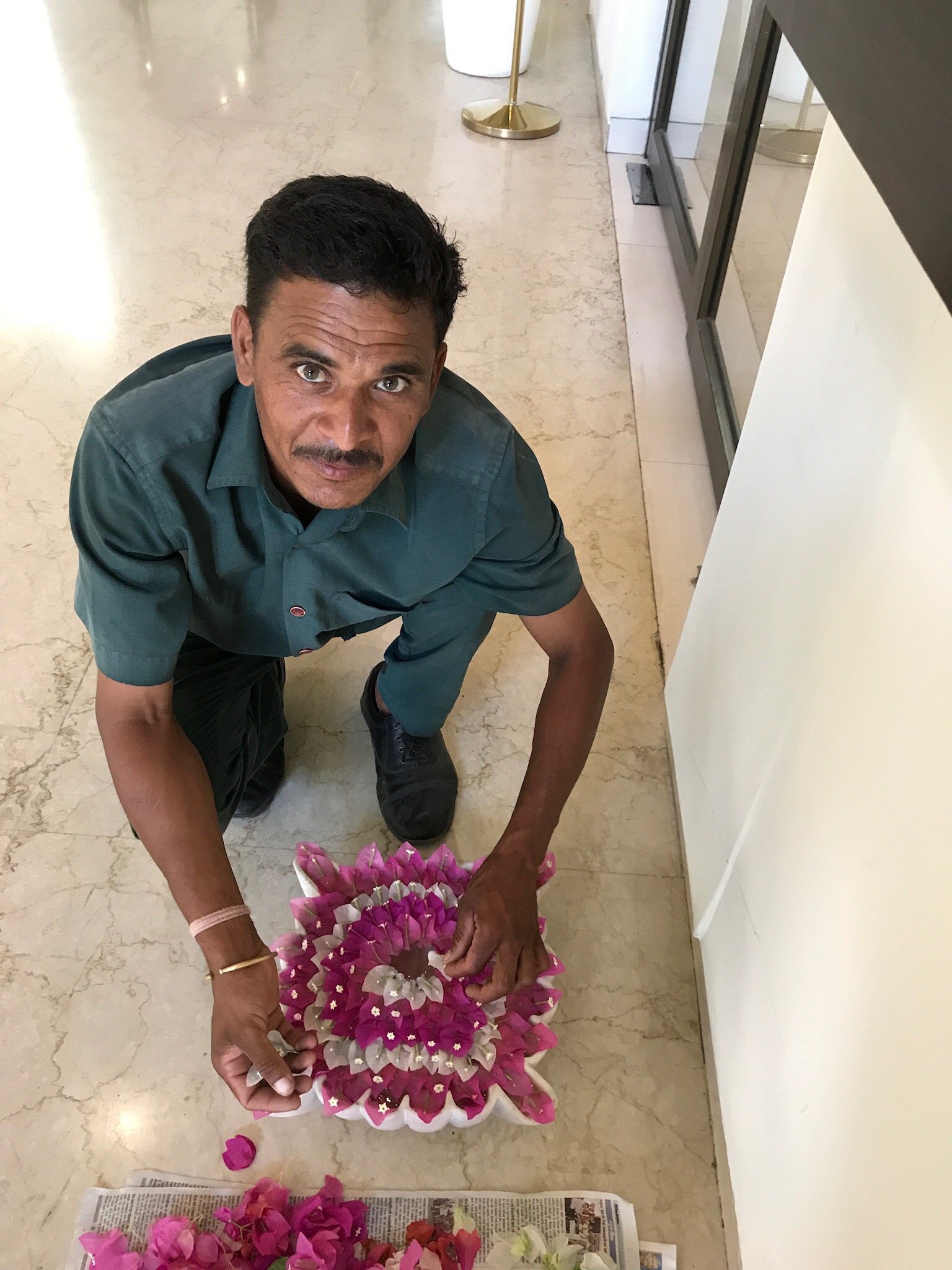
Celebrating life…

We always wait for an occasion to celebrate life.  Why do we need to do so.  Why not learn to celebrate life every day without any reason ?  Is it difficult ?  I do not know.  May be we are conditioned to do so.  As we grow up as a child, we naturally celebrate life every day without any reason.  We play, laugh, cry without any provocation.  We do what we feel like doing and never regret our actions.  But as we grow up as an adult, we cease to do so.

It may be worthwhile to examine as to why this phenomenon happens.  One of my hypothesis is that the child in us gradually disappears.  We do not live life naturally.  We put up a facade in front of others.  We have an inner and an outer self.  The inner self is the child in us.  It is natural and wants to celebrate life as it comes.  The outer self is regulatory.  It tries to control us and our behaviour.  We behave as others want us to behave rather what we feel.

The second hypothesis is that our family, society and work environment also determines our behaviour.  Fear is instilled in us and we are generally pulled up for laughing aloud or celebrating without reason.  It is considered frivolous to enjoy life.  People around you tell you that you are not taking life seriously.  You seem to think that you have arrived in life.  All this makes us circumspect and look at life very seriously.  We may end up crying when need to laugh it out and laugh at moments of distress.

The third factor could be the perceived image we want to create in society.  We behave the way we want others to perceive us.  We are conditioned by circumstances and people around us.  We do not want to be our natural self lest we are misunderstood by others around us.  We behave in society’s acceptable ways.  It is like I take a particular subject in school or college not because I love the subject but because society will think I am crazy if I take something I like but is not considered normal.

It is time to wake up.  It is time to celebrate life as it comes every day.  Why not get up in the morning and think that today is the best day of your life ?  Why not be grateful to God for bestowing you with all the good things in life.  Why not enjoy today better than yesterday and also the unimaginable tomorrow ?  Why postpone a celebration for an occasion.   Why not tell people around you how much you love them ?  Why not tell your child how talented she is ?  Why wait for the exam results to celebrate your child’s talent ?

I love driving.  Sometimes, I have gone for a drive with my family without any destination in mind.  I have driven to wherever my heart wanted me to take.  Similarly, why not celebrate life without any reasons.  Why wait for a tomorrow to celebrate life ?  After all the tomorrow may never arrive.  Like they say, yesterday is “history”, tomorrow is “mystery” and today is “present”.  Lets celebrate today.

Let us the learn to celebrate life ( as in the photo above) from the gardner, who creates a thing of beauty from Bougainville flowers.

It may not be worthwhile to look at the past and lose our sleep.  It may be not realistic to look at the future and hope something is likely to happen.  It would be better to enjoy today.  It may also not be worthwhile to look for reasons to celebrate.  Let us celebrate life without reasons.  Let us create reasons to celebrate life rather than wait for occasions to occur in life.

The day to start is today and the time to start is now.

S Ramesh Shankar

Leadership lessons from Prime Minister Vajpayee

India lost its three time Prime Minister Atal Bihari Vajpayee on 16th August 2018 at the age of 93 after a prolonged illness. The nation received the news with numbed silence. I have personally been a great admirer of this person. I do not have any political affiliations but the personality of this human being was magnetic to say the least and that made me a ardent fan. I was saddened by his death and decided to list ten learnings from this statesman, which any human being could try to imbibe in their daily life.

Inclusiveness was in his blood. He had expressed in thought and action through his speeches, poems and actions. I have not heard or met anyone who has known him complaining of his ignoring them. Even the common man felt he was accessible and was never felt excluded in any public actions or policies.

One of the most difficult tasks of a leader is to balance the team, especially when you have members with opposing ideologies to manage. He had the ability to manage diversity and foster inclusiveness through his fairness and equity. Such was his stature and credibility that his silence spoke more than his words.

Even after balancing a team, it is important for a leader to carry along every member of his team. He was a master of listening to all shades of opinion and still being decisive. He had the ability to carry along people with opposing views gracefully. This is difficult to practise especially in a diverse political spectrum when you are running a coalition government.

His ability to build consensus was par excellence. If we look back on the decision to go nuclear or win a war against an erring neighbour was built on political consensus. He was diplomatic but firm. He could place national interests above narrow political considerations and influence people of all political shades to support his views in the overall interest of India.

We hear stories of how he fell on the feet of a tribal woman entrepreneur, who gave employment to hundreds of needy women. His outreach on the Kashmir issue has no parallels in Indian history. He could extend a hand of friendship even to his rivals provided it was in national interest. Humility and humaneness was felt in his thoughts and actions.

He was one of India’s best known orators. He could make his critics laugh even while made a scathing attack on their stance. Such was his stature in parliament and outside that even the opposition listened to him in rapt attention when he spoke. I have repeatedly listened to his speeches to learn the art of differing without hurting others.

His sense of humour had to experienced to be believed. He was an inspirational poet. He could use words, gestures and even pauses to silence his critics. He could sway the sombre mood of any audience with his humour. Even in humour, he had the grace of being dignified.

A statesman is judged by his actions and not by his words. His ability to reach out and contribute to international issues without compromising on India’s interests raised his political stature. He did not give up on resolving international conflicts even when all his humanitarian gestures were snubbed. Such was his personality that even the government in power made him India’s leader in the United Nations although he was only the leader of the opposition.

India’s interest was the basis of all his decisions. He never entertained any action, which was against national interest. We hear instances wherein he even declined suggestions even from his cabinet colleagues if it was not in overall national interest. He was also willing to invite suggestions from political rivals on national issues.

One of his best qualities I would love to imbibe is his ability to criticise respectfully. I have heard many of his speeches in parliament – both as prime minister and as leader of the opposition, wherein he has been scathing in his criticism but without crossing the line of dignity. No politician could ever raise a finger against him for his language, delivery or content although they may not have agreed with his views on any subject.

I have attempted to illustrate a short list of ten qualities, which I admired in him. I am too small a person and have never met him so do not know much about him except from information in the public domain.

This is just my tribute to PM Vajpayee as a common man on the day when his body was cremated in New Delhi and the entire nation paid their last respects to him.

RIP

S Ramesh Shankar

16th August 2018

Process – means or end ?


Is a process a means to an end or an end in itself ?  In my view, it should be only be the means to an end and not an end in itself.  However, in many organizations today, processes seem to become an end by itself.  I was recently on a field visit to another country.  The CFO was trying to explain to me as to how they have migrated for all their banking needs including employee salary accounts from a multinational bank to a local bank.  When asked for the reasons, he explained as to how it took more than ten days even to open a salary account in the multinational bank as compared to the local bank, which could do the same in one day.

This incident reminded me as to how we have become slaves of organisational processes.  This is more prevalent in multinational organizations rather than local ones. One of the reasons many multinational organizations are losing their competitive advantage in many markets is that they seem to be wedded to processes more than the results expected out of them.

It is time to question all our processes and ask ourselves as to whether we need them.   We need to examine whether each process meets an end or only delays an action to achieve a goal.  Many processes may have evolved over time due to various historic reasons.  The origin of some of them may have been linked to ensure better compliance or correct some serious violations in the past.

I have two interesting learning experiences to simplify processes.  The first was when I went to a school in Bangalore to seek admission for my son in XI standard.  The school refused to give admission forms. I was disappointed.  They told me that there was no need to fill up an admission form before admission.  I thought it was a polite way to decline admission for my son in the school.  However, they said that it was enough to give a copy of the final mark sheet.  They would short list based on his marks and then put up the selected list of students on the notice board.  We could then fill the admission form after that.  It actually happened that way and it was a simplified admission process.  This not only reduced the cost for parents but eliminated thousands of students to fill up forms and pay for them even though the majority of them would never get admission in that school.

The second instance was when I wanted to buy a small speaker to listen to music in my office.  I made a purchase requisition and even after two months, the speaker could not be procured.  When I enquired they said that they could not identify a vendor since most of them were not agreeable to our payment terms.  However, when I raised this issue with the head of supply chain in my organisation, we decided that it was a silly process to follow for an item of so less value.  Hence, after this incident, we decided that we will allow all employees to procure items less than Rs. 25000 ( $400) directly using their credit cards and claim the same through a reimbursement process.  Sometimes, the cost of the process could be more than the cost of the item to be procured. 

It is like having a process to procure these mud pots(as in the photo above) to be more expensive than the cost of the pots itself.

Both these incidents taught me that it is possible for us to challenge every process in any organisation and simplify it.  We simply have to ask whether a process is a means to an end or an end by itself.  Further, we need to examine if it serves any useful purpose.  Otherwise, we just need to question it and eliminate it.

Let us start today.

S Ramesh Shankar