The plight of decision makers in a crisis

Pond Heron

I have always wondered how difficult it would be for decision makers to make decisions in a crisis. The current Covid crisis is not an exception. Every country is trying to deal with the crisis in their best possible way. However the citizens are unhappy with the decisions being taken by their respective governments.

In a democracy, it is much more difficult to take decisions as compared to other forms of governments. Here, if you decide you are criticised and if you don’t, you are criticised. Either way, there will be people waiting for you to take a decision and then they are ready to pounce on you as to how bad a decision it was.

I sometimes wonder if these critiques ever put themselves in the shoes of those who decide. If there is a lockdown, they say livelihood is lost and if there isn’t one they say lives are lost. Those in governance are finding the right balance between protecting lives and saving livelihoods.

The beauty of a situation like this is that everyone becomes an expert on everything. We have common men and women advising us on how to deal with preventive health to deal with the virus. Whereas, even doctors and health workers are finding it difficult to deal with an unknown virus.

We have arm chair economists advising us on how to revive the economy and save livelihoods at the cost of lives. Some business honchos have even gone to the extent of saying that the economic downturn will result in more loss of lives than the Covid crisis.

The governments in the centre and the states are trying their best to decide what they think is in the best interest of its citizens. However, we all are restless and are ready to pounce on any decision taken by the state or the centre in our country. We do not realise that the people we have elected to take decisions supported by smart and knowledgable bureaucrats have more information than we have to decide on matters to deal with this crisis.

While we all have become public health experts, economists, administrators and futurologists, we forget our duties as citizens. We are the first to violate a guideline set by our local government on the pretext of being educated and knowing what we are doing. We go out to buy things which are not essential or demand for services from others risking their own lives for our comfort.

We do not realise how difficult it is for the urban and the rural poor. The situation is tough especially for the urban poor and most developed cities today run on the work of the migrant labourers. As citizens, we need to find ways to support these people during this crisis and not sit back and blame only the government in power for not doing anything. Are we capable of taking care of our security staff, our maids, our gardener’s, housekeeping staff and so on. If each of us commit to take care of people who touch our lives every day then the problem is simpler for the government to handle.

In a crisis, the most important factor to remember is that there is only one leader and all of us have to be diligent followers. Like in the Army they say, the word of the commander is their religion. So, we need to behave. We have elected governments at the centre and the states and we need to trust our people in power including politicians and bureaucrats to deal with this crisis effectively.

Let us learn to be trusted followers rather than quack experts in every field especially in a crisis. If I can put myself in the shoes of those in governance, I may realise how difficult it is to decide. I am an office bearer in our community association and can tell you that it is very difficult to deal with community decisions in a crisis like this. We have only 25 families living in my community. Imagine someone deciding on behalf of a billion people or even a few millions in a state.

As in the photo above, it is wiser to sit at home and admire the pond heron eating fish in your pond rather than sit in your arm chair and criticise the decision makers in a crisis.

Trust is key in a crisis. Follwership is our duty. Let us empathise and appreciate the difficult role of the decision makers by being self disciplined and following whatever guidelines are given to us.

Let us make a difference by being positive always and being enablers rather than detractors in a crisis situation.

S Ramesh Shankar

2nd May 2020

How to reduce employee cost without reducing employee numbers ???

I have always wondered as to why organizations tend to focus on employee cost reduction at the first instance under any crisis situation! While employee cost in most organizations especially in manufacturing sector will be a negligible as compared to material cost, the tendency is to focus on how to reduce employees in order to tide over any crisis.

    I was reminded of the famous British management thinker Charles Handy.  He once spoke in Delhi for the Economic Times summit and shared a beautiful formula, which can be depicted as follows :

                                              Business Success = ½# x 2*x 3$

Note ; # reduce employees by half, * double your sales and $ profits will treble.

He explained that most CEOs believe that in any crisis situation if they are able to reduce employees by half, their sales will double and their profits will treble.  He further went to state that as long as CEO’s remember that they could also fall in the half of employees who are let go, they would take the right decisions for their organizations.  This is the bitter truth even today.

     The Covid crisis will impact businesses adversely.  Many CEOs would think of ways and means of cutting employee numbers so that they can tide over this business downturn.  While that may be an easy way out, CEO’s may have to realize that employees win customers and employee loyalty sustains organizations.  With this premise in mind, I thought I could share ideas of how employee cost could be optimized even without having to reduce employee numbers.

    In this article, I will attempt to share a few ideas of employee cost reduction without having to reduce manpower :

a.     Employee Salary reduction :  While many organizations may consider this a taboo, it is fine in a crisis situation to reduce salaries rather than people losing jobs.  It has to start from the CEO and go downwards and not the other way around.  If possible, we should spare the lowest level of employees in this exercise.  

b.     Salary structure review :  This could another way of linking salary more to performance than level or designation.  Further looking at fixed to variable pay, review increments, promotions linked to role, salary bands etc.  There are multiple ways to do this and can be done without employees losing jobs.

c.     Benefits Review :  There are various benefits which organizations evolve over a period of time.  This is the time to review the same and monetise wherever possible or eliminate them.  It could range from leave, holidays, copay in medical insurance and so on.  There are again varied ways of dealing with this without impacting employees in any direct way.

d.     Review Organization structure:  It is the right time to make the organization leaner and more effective.  Invariably, in most organizations, layers get added just to create positions for people to be promoted or someone’s ego to be satisfied.  Every part of the organization can be reviewed and all unnecessary levels can be eliminated.  This will make it more efficient and responsive to customers.

e.     Employee involvement & engagement :  This is the best time to harness the full potential of employees.  Those who do the work know best where we could improve and reduce cost.  So, if we are able to find ways and means of involving employees in idea generation and execution, cost reduction can easily be achieved in different aspects of work in all functions.  We need to suitably reward employees for the same linking it to the savings accrued and the benefits to the organization.

f.      Hidden subsidies :  Organizations tend to build a lot of hidden subsidies which are neither visible to the employees nor to the organization.  It may be time to review all of them and again monetise them or eliminate them if they don’t serve the purpose for which it is created.  This could include canteen, transport, concierge, travel allowances etc. 

g.     Review office spaces :  Real estate is one of the biggest cost amongst all overheads.  Now that even the sceptics have accepted “Work from Home” as an option, it may be worthwhile to review the need for large office spaces and reduce cost.  We could consider 50% of field sales and service staff to work from home and visit offices may be once a week to submit claims or follow up on issues.  We could review offices, factories, guest houses and the like and rationalize the same.  We could also eliminate fixed seats for employees and make flexible offices spaces as a way of life. 

Employee will not mind any of these changes provided we communicate effectively and authentically.  Any employee will appreciate that it is better to take a cut in salary or benefits rather than lose a job.  If employees are told that all these measures will ensure job security for all, it will be highly appreciated.  The success of all these measures will lie in effective planning, communication, execution and rigorous reviews.

I thought about all this with only one objective of saving jobs.  I will be happy to consult with any organization pro-bono to plan and execute any or all of the above ideas.  I can detail them out for you in consultation with your internal teams so as to customize it for your organization.

I need not be paid a single rupee for this service.  If the organization is able to save jobs, my mission is accomplished.  If the organization saves employee cost without reducing its number of employees and is able to quantify savings, I will be delighted.

At the end, if organizations achieve their goals, we can find ways and means of contributing to my social cause of “Eradicating preventable blindness amongst children” and I will be highly indebted to them always.

I have committed to find ways and means of giving back to society in the second innings of my life and saving employee jobs in a crisis could be one way of accomplishing my mission.

Locked in because of the lockout

We always have a ready excuse in life for everything. When people ask me, why were you not able to complete a task, I may say there was a lockout and you know how you feel lonely and left out in such a situation.

We may blame the rains for coming in late to office or the sun for not going for a evening walk. It is possibly human to invent reasons for not doing something. But, if we dig deep, we will find, we do not have an excuse for anything.

It can be as simple as promise made to my kid to take her for a circus or as official as a commitment to send a presentation to a customer on a particular date. While we always find excuses to justify our behaviour but deep down in our hearts we know we have none.

While this may look simple, it is possibly one of the most difficult things to achieve in life. What I find interesting is that the simplest things in life are the most challenging. It may easier to fix a machine under breakdown than to change a simple habit of ours every day.

I learnt it the hard way to be punctual in life after I missed an important event in my school days. Since then, I have been punctual in all my personal and official engagements. What I find interesting is that late comers to work are never late to miss a train or a plane during vacations. This means that if we are passionate about something, we can make the change.

This is equally true in life. The lockout is beyond our control. It is possibly one of the best ways to prevent the unknown virus to spread. However, to keep our mind locked in and blame the lockout for that is not justifiable. I know people in life who will always find a reason for things going wrong for them. They are never happy. On the other hand, you find people, who are always happy irrespective of the fact that they may not have all the luxuries of life with them.

So the simple lesson to be learnt is that we need not feel locked in even in a lockout. We can find hundred and one ways of keeping ourselves engaged and innovating and thriving in this environment. I put my thinking cap on and got so many ideas to write about, which I never got during the normal days of the year so far. So, it is upto us to change any situation to our personal advantage.

If we believe the lockout has not only physically kept us indoors but also mentally, we have none to blame than ourselves. Our mental potential is unlimited. Irrespective of your field of interest or work, you could discover new things everyday even within the confines of your home. There is so much to learn, so much to observe, so much to read and reflect and so much to change.

The sooner we realise this phenomenon, the better it is for us as evolving human beings. If not, we get stuck like the snail in its shell. We may be putting our head in the sand like the Ostrich and thinking that the world has come to an end. We need to realise that we have sunk our head and the world around us is still alive and kicking.

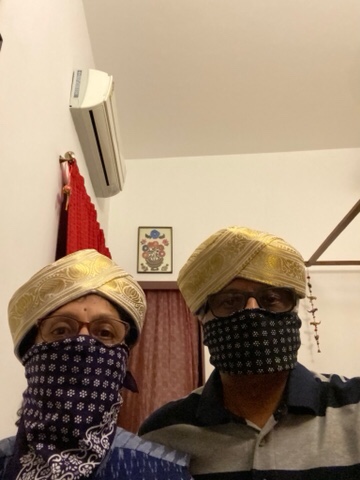
As in the photo above, we innovated on the cap and the mask to have fun even during the lockdown.

Time to get up and awaken ourselves is now. Are we ready ?

S Ramesh Shankar

20th April 2020